Maasai Warriors Jump High can look surprising from the outside, but its meaning becomes clearer when history, place and everyday social rules are considered together. This guide explains maasai warriors jump high with context rather than stereotypes.
Maasai Warriors Jump High: meaning and cultural context
- Maasai Warriors Jump High can vary by region, family, faith and generation.
- The custom may look different today than it did a generation ago.
- One striking practice should never be treated as a rule for every person in a country.
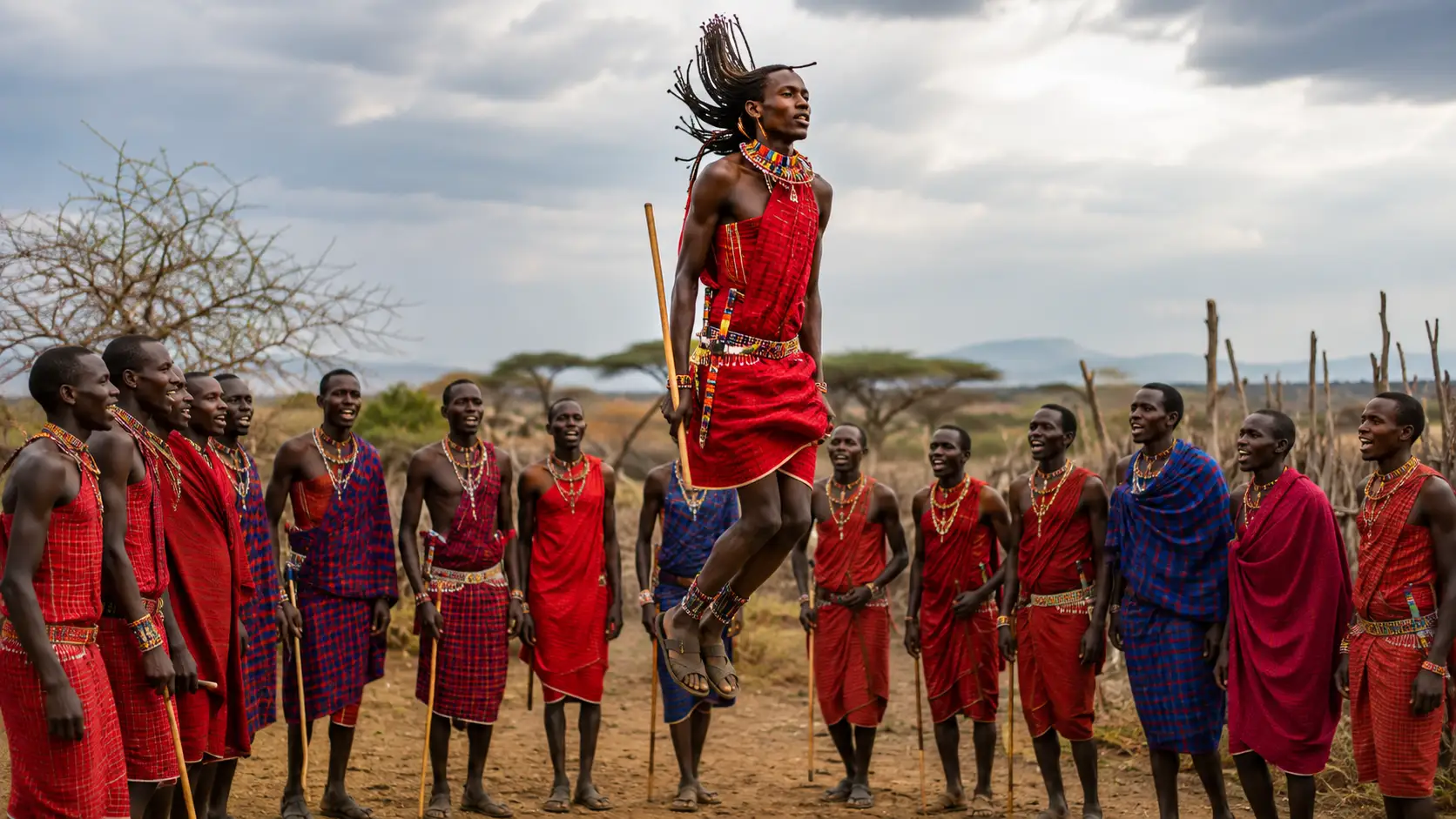
A circle of young Maasai men is singing when one figure suddenly rises above the others.
He jumps almost straight upward, lands, then springs again. There is no running start and little of the dramatic crouching associated with a basketball jump. Around him, voices continue the rhythm while another jumper prepares to enter.
This is adumu, the famous Maasai jumping dance.
So why do Maasai warriors jump so high? The jumping is a traditional form of dance associated particularly with young men in the warrior age-grade, known as ilmurran or morans. Height can display physical ability and confidence, especially in competitive or celebratory settings, but adumu is not simply a high-jump contest. It is also about rhythm, youth identity, social connection and taking one’s place within the group.
That distinction matters, because one of the world’s most photographed cultural performances is often given a much simpler explanation than the reality.
What Is the Adumu?
The Maasai live primarily in Kenya and Tanzania, and traditionally organize important parts of social life through age-sets and stages of responsibility.
Young men historically pass through a period of moranhood, often translated into English as “warriorhood.” UNESCO describes Maasai male rites of passage as a progression in which young men are prepared for moranhood, adulthood and eventually eldership, while learning responsibilities involving livestock, community life, conflict management and cultural knowledge.
Adumu is strongly associated with this period of youth.
The word refers specifically to jumping movements performed in dance. A detailed ethnographic and biomechanical study published in PLOS ONE describes young Maasai men performing repeated two-legged vertical jumps while singing together, with individual jumpers entering the performance as part of a larger rhythmic group.
That larger group is easy to overlook.
A photograph freezes one man in midair. The culture around him is moving too.
Is the Goal Really to Jump the Highest?
Sometimes physical prowess matters. But the answer is more complicated than many travel descriptions suggest.
The Smithsonian Folklife Festival describes one form of adumu associated with the coming-of-age process as competitive, with young men taking turns jumping to demonstrate physical prowess and attract the attention of women.
That has helped create a popular story: Maasai men jump as high as possible, women watch, and the highest jumper wins a bride.
The problem is that this turns a varied social practice into a single rule.
Researchers observing adumu during a Maasai wedding in southern Kenya found something striking. Jump height was not the central goal of that performance. Men who jumped lower were still cheered, and the researchers found much greater consistency in the rhythm and repetition of the jumps than in their height. They concluded that the dance was better understood as an interactive group performance than as a Western-style sporting contest.
Both descriptions can be true because the context can change.
At one ceremony, physical display and courtship may be important. At another, shared rhythm, friendship and celebration may matter more.
There is no single Maasai rule saying that the highest jumper automatically gets the bride.
Why Does the Jump Look So Extraordinary?
Part of the mystery comes from the style of the movement.
The jumper rises from roughly the same spot again and again while keeping the body controlled and upright. Against a line of standing dancers, the sudden vertical movement looks unusually dramatic.
And unlike a sport in which an athlete gets one carefully prepared attempt, adumu is rhythmic. The jumper must fit his movement into the song and keep going.
The PLOS ONE researchers measured 160 jumps by 15 young men during one wedding performance. The average jump height in that particular sample was about 43 centimeters, with considerable variation between performers. More interestingly, the timing of the repeated jumps was far more consistent than their height.
That suggests the impressive part is not only how far someone leaves the ground.
It is the combination of height, repetition, balance, timing and apparent effortlessness.
Adumu is also practiced by young people in social and playful contexts, giving performers familiarity with a movement that can look extraordinary to someone seeing it for the first time.
The Singing Is Not Background Music
Watch only the feet and much of the dance disappears.
Adumu belongs to a musical performance created collectively. The men sing, respond to one another and establish a pulse that the jumping follows.
In the wedding performance studied by researchers, cheering was directed not only toward the jumpers but also toward singers and friends. The researchers emphasized this interaction as evidence that the dance helps create unity among the young men performing it.
The jumper is therefore not performing alone.
His body becomes one part of a larger rhythm.
This explains something a photograph cannot. Adumu is spectacular visually, but its meaning is partly relational. The people surrounding the jumper are not merely spectators waiting to see who wins.
They are helping make the performance.
What Does Warriorhood Mean Here?
Calling the performers “Maasai warriors” can also create misunderstanding.
Moranhood is not simply a military job comparable to being a professional soldier. It is an age-grade with social, educational and ceremonial significance.
UNESCO’s documentation of Maasai rites of passage describes young men learning responsibilities, indigenous knowledge, livestock practices, traditions and methods of managing conflict. The movement from one age group to another also transfers responsibilities and authority between generations.
Historically, defending livestock and communities formed part of warrior responsibilities, which helps explain why qualities such as stamina, courage and physical confidence carried prestige.
But reducing a moran to “a man trained for combat” misses the social institution around him.
Adumu belongs to that larger world of youthhood, belonging and transition.
Is Adumu Only Performed at Coming-of-Age Ceremonies?
No.
It is strongly associated with Maasai youth and rites of passage, but researchers have also documented it at weddings and as part of play among young men.
Today, visitors may also encounter versions of the dance at cultural centers, community tourism programs and public performances.
That creates another complication.
A performance for visitors may be genuine in the sense that the movement, songs and cultural identity belong to Maasai performers, while still occurring outside the ceremony where a similar dance might traditionally appear.
Tourism can therefore make adumu more visible while stripping away some of its original social context.
Seeing the jump is not necessarily the same as understanding the event.
Is the Tradition Still Practiced Today?
Yes, but the cultural system surrounding Maasai rites of passage is changing.
In 2018, UNESCO placed three interconnected Maasai male rites of passage in Kenya, Enkipaata, Eunoto and Olng’esherr, on its List of Intangible Cultural Heritage in Need of Urgent Safeguarding.
UNESCO reports that traditional transmission has weakened because of changes including formal education, land use, livelihood patterns and pressures affecting pastoralism. At the same time, communities continue efforts to document and transmit cultural knowledge between elders and younger generations.
That does not mean Maasai culture is disappearing.
It means it is changing, like every living culture.
Adumu can now exist in several worlds at once: inside community celebrations, in rites of passage, at weddings, in youth social life and sometimes before cameras.
Frequently Asked Questions
Do Maasai men jump to choose a wife?
Not according to any universal rule. Physical display and attraction can be part of some performances, but research shows that adumu can also emphasize rhythm, friendship and group participation rather than jump height.
Are all Maasai men warriors?
No. “Warrior” is commonly used to translate the moran or ilmurran stage of life for young men within the traditional age-set system. Men later move into elderhood and different social responsibilities.
Is adumu performed only in Kenya?
No. Maasai communities live on both sides of the Kenya and Tanzania border, although practices and terminology can vary between communities and regions.
Is the jumping a competition?
It can contain competitive or demonstrative elements in some settings. In other settings, researchers have found that jumping higher is not the main objective.
The famous photograph shows a man suspended above the ground. What it cannot show is the network of voices beneath him.
That is the real key to adumu. The height attracts the eye, but the dance belongs to the group. What can look like an astonishing test of individual athleticism is also a way of moving, singing and being recognized together.
Further cultural context
To keep maasai warriors jump high in perspective, explore related Daily World Culture stories and UNESCO Intangible Cultural Heritage. Strong cultural research compares sources, regions and generations instead of treating one memorable detail as universal.