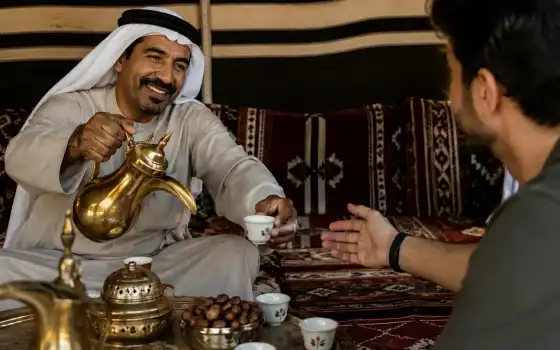
Moroccan Tea Traditions can look surprising from the outside, but its meaning becomes clearer when history, place and everyday social rules are considered together. This guide explains Moroccan tea traditions with context rather than stereotypes.
Moroccan Tea Traditions: meaning and cultural context
- Moroccan Tea Traditions can vary by region, family, faith and generation.
- The custom may look different today than it did a generation ago.
- One striking practice should never be treated as a rule for every person in a country.
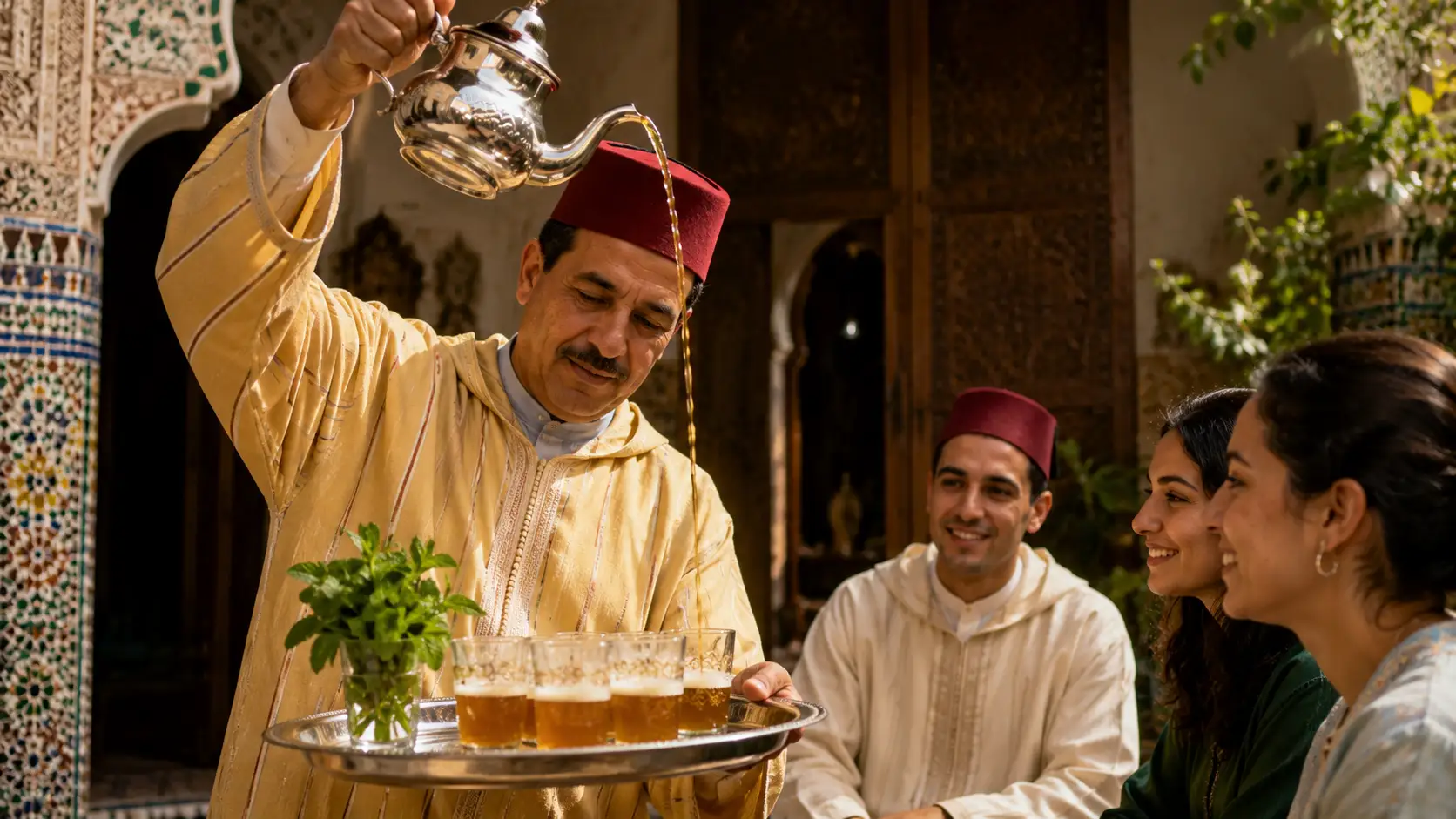
The teapot rises. Twenty centimeters above the glass becomes thirty, then forty. A thin amber stream falls through the air, somehow landing neatly inside a small decorated glass while a pale layer of bubbles forms on top.
Why risk pouring hot Moroccan mint tea from so high?
The height is partly practical and partly social. Pouring from above aerates the tea and helps create its characteristic foamy surface. It can also mix the brew and cool it slightly. Just as importantly, controlling that long stream turns an everyday drink into a visible act of care, skill and hospitality. Moroccan sources regularly describe tea as a gesture of welcome, with the high pour forming part of its distinctive service.
What looks like a flourish for tourists has a purpose. And the higher the pot rises, the more obvious the skill becomes.
The Foam Is Part of the Point
Look closely at a properly high-poured glass of Moroccan tea and you will usually see bubbles collecting at the top.
That foam is one of the clearest reasons for the dramatic pour. As the narrow stream falls through the air and strikes the tea in the glass, it introduces air and creates froth. Moroccan descriptions of tea service commonly associate a good layer of bubbles with careful preparation.
Pouring gently with the spout just above the rim can fill the glass, but it does not produce the same effect.
The height also helps circulate a drink that may contain strongly brewed green tea, mint and a generous amount of dissolved sugar. In some preparation methods, tea is poured into a glass and returned to the pot before serving, helping blend the contents without simply stirring everything with a spoon.
There is a small physical benefit too. A thin stream exposed to the air loses some heat, so the pour can cool very hot tea slightly. That does not make the drink cold. Moroccan mint tea is still normally served hot.
The Higher Pour Shows a Steady Hand
There is another reason the scene attracts so much attention: it is difficult.
A practiced server can lift the teapot while maintaining a narrow, uninterrupted stream into a glass with a surprisingly small opening. Raise the pot too quickly, change its angle or lose concentration, and the tray gets the tea instead.
That difficulty gives the gesture social meaning.
Preparing tea for someone in Morocco is often more than providing a beverage. Tea accompanies visits, conversations, family gatherings and moments of welcome. The host is giving attention to the process, not merely placing a drink on the table. Moroccan reporting describes offering mint tea as a familiar sign of hospitality and friendship.
The elegant pour makes that attention visible.
It can certainly be performed more dramatically in restaurants, hotels or places where visitors are watching. But the underlying technique did not begin as a tourist show. High pouring belongs to established Moroccan tea practice, even though individual families may pour from different heights and with different degrees of ceremony.
What Is Actually in Moroccan Mint Tea?
The drink often called Moroccan mint tea is usually known simply as atay.
Its classic base is Chinese green tea, especially tightly rolled gunpowder tea, combined with fresh mint and sugar. The mint commonly used is a type of spearmint, while other herbs may appear depending on season, region and household preference. The Washington Post, reporting on Moroccan tea culture, noted variations including wormwood, marjoram, sage and verbena alongside mint.
So there is no single pot that represents every Moroccan family.
Some tea is extremely sweet. Some is less sweet. Mint may dominate one version while green tea is stronger in another. In colder weather, aromatic herbs can change the character of the drink completely.
The ritual also varies across Morocco and the wider Maghreb. Tea culture among Sahrawi communities in southern Morocco, for example, has its own preparation practices and social rhythms. It should not be treated as identical to every tea service in Casablanca, Fez, Rabat or the Atlas Mountains.
An Imported Leaf That Became Deeply Moroccan
One of the most surprising things about Morocco’s famous tea tradition is that the tea plant itself is not Moroccan.
Tea was known among Moroccan elites before the modern era, but historical research places the major expansion of tea and sugar imports in the nineteenth century. Historian Graham H. Cornwell’s research on tea and sugar in Northwest Africa begins with the first major shipments in the 1850s and examines how people gradually gave these imported products new local meanings.
Chinese green tea entered through expanding international trade. By the later nineteenth century, sweetened tea had spread far beyond elite circles and become increasingly embedded in everyday life.
A popular history sometimes claims that the Crimean War alone caused British merchants to redirect surplus Chinese tea to Morocco. That story appears frequently, but the broader history is more complicated. Long-term trade changes, falling prices, commercial treaties and expanding import networks all helped tea become widely accessible.
Moroccans then transformed an imported commodity.
Chinese leaves were combined with locally familiar herbs, sugar, Moroccan metal teapots, small glasses and a developing etiquette of preparation and welcome. The result was not simply foreign tea consumed in Morocco. It became Moroccan atay, with its own taste, objects, gestures and social meaning.
Why Tea Became a Language of Hospitality
Imagine arriving at someone’s home and being offered a glass before serious conversation begins.
The drink creates time.
Water must be heated. Tea must be prepared. Mint is added. Glasses appear. The pot arrives on a tray. Someone pours.
That slow sequence allows people to sit together rather than rush immediately to the purpose of the visit. Tea can accompany family conversation, meetings between friends, business discussions or the welcoming of someone new.
This is why focusing only on the height of the pour misses what is happening around it.
The spectacular stream may be the photograph everyone remembers, but the larger ritual is about attention to a guest. Smithsonian Magazine’s photography archive contains repeated examples of Moroccan tea being documented specifically in moments of hospitality, including tea offered to visitors in homes and during shared meals.
The drink gives hospitality a physical form.
Does Every Moroccan Pour Tea Over Their Head?
No.
There is no national rule specifying an exact height, and not every glass of tea comes with an acrobatic performance. At an ordinary family table, the pot may be lifted enough to produce foam without being raised dramatically. A skilled server entertaining guests may pour much higher.
Restaurants and tourist settings can exaggerate the gesture because people enjoy watching it.
That does not make the custom fake. It simply means a genuine technique can also become performance.
The same is true of many cultural practices. A movement used naturally at home may become more polished at a celebration or more theatrical when an audience is present.
Frequently Asked Questions
Why does Moroccan mint tea have foam on top?
Pouring the tea in a narrow stream from above introduces air and creates bubbles. A foamy surface is commonly associated with a carefully poured glass of Moroccan tea.
Is Moroccan mint tea actually made with black tea?
Usually not. The classic version uses Chinese green tea, particularly gunpowder green tea, with fresh mint and sugar.
Does pouring from high up cool the tea?
Slightly. A narrow stream has more contact with the air, but the tea is still served hot. The more culturally important effects are aeration, foam and the skill of the serving gesture.
Is mint tea served only to tourists?
Not at all. Tea is part of everyday Moroccan social life and is widely associated with receiving guests, family gatherings and friendship.
The next time a Moroccan teapot rises far above a tiny glass, the gesture may look less mysterious. The falling stream is doing several things at once: building foam, finishing the drink and displaying a practiced hand. But its most important ingredient may be the time and attention being offered with it.
A glass of tea can be filled from an inch away. Raising the pot turns serving it into something people remember.
Further cultural context
To keep Moroccan tea traditions in perspective, explore related Daily World Culture stories and UNESCO Intangible Cultural Heritage. Strong cultural research compares sources, regions and generations instead of treating one memorable detail as universal.