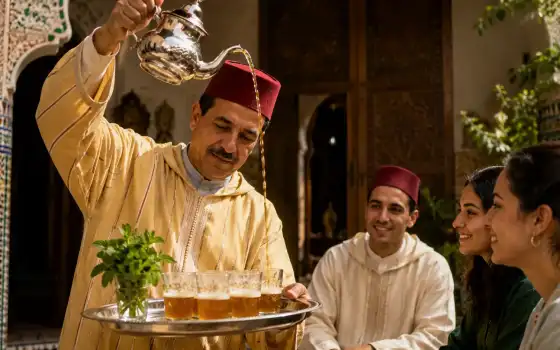
Arab Hosts Keep Refilling can look surprising from the outside, but its meaning becomes clearer when history, place and everyday social rules are considered together. This guide explains arab hosts keep refilling with context rather than stereotypes.
Arab Hosts Keep Refilling: meaning and cultural context
- Arab Hosts Keep Refilling can vary by region, family, faith and generation.
- The custom may look different today than it did a generation ago.
- One striking practice should never be treated as a rule for every person in a country.
The cup is tiny. The serving is even smaller.
You drink the fragrant Arabic coffee, hand the cup back, and almost immediately the host pours again. Finish that one, and another refill may follow.
At first, it can seem as if the host simply refuses to let you stop drinking.
But in many Arabian Peninsula and Bedouin-influenced hospitality traditions, the repeated refill is the point. Arabic coffee is served in small amounts so the host can continue offering it. The ritual communicates generosity, attentiveness and welcome. When the guest has had enough, there is traditionally a simple signal: gently shake the empty cup from side to side.
Until then, the person holding the coffee pot may reasonably assume you are ready for more. UNESCO specifically identifies the cup-shaking gesture as part of Arabic coffee etiquette in Jordan, Oman, Qatar, Saudi Arabia and the United Arab Emirates.
The Cup Is Supposed to Look Almost Empty
For someone accustomed to a large mug of coffee, the first pour can look surprisingly stingy.
Arabic coffee, often called qahwa or gahwa depending on local pronunciation, is traditionally served in a small handleless cup called a finjan. In Gulf traditions, it may be poured from a long-spouted pot called a dallah.
And the cup is deliberately not filled to the top.
Official Emirati descriptions of coffee etiquette say the cup may be filled only about one-quarter full before being offered to the guest. UNESCO’s original documentation of the tradition likewise describes partial pours followed by refills.
The small serving changes the entire social experience.
Instead of receiving one large drink and being left alone with it, the guest repeatedly interacts with the host or server. A cup is accepted, drunk, returned and offered again.
Coffee becomes a conversation conducted with objects.
Why Doesn’t the Host Just Ask If You Want More?
Because the ritual already contains an answer.
If you return the cup normally, another pour may follow.
If you gently shake the cup from side to side as you return it, you are signaling that you are finished. Saudi cultural documentation states the rule very plainly: if the guest does not shake the cup, the server pours more. Jordan’s official visitor guidance similarly tells guests to shake the cup when declining another refill.
For a visitor who does not know the signal, this can produce a comic misunderstanding.
You drink because the host pours.
The host pours because you keep handing back an unshaken cup.
Neither person realizes the other is waiting for a different message.
Refilling Is a Form of Attention
The deeper meaning is hospitality.
UNESCO describes Arabic coffee as a symbol of generosity and notes that guests and older people are traditionally served first. Coffee appears at home visits, weddings, majlis gatherings and occasions involving discussion, reconciliation and community life.
In other words, the host is not simply giving you caffeine.
They are continuing to look after you.
Traditional Saudi etiquette even describes the person serving coffee as remaining standing with the dallah until the guests have indicated that they are satisfied.
The repeated pour says something close to: there is still more for you here.
In cultures where generosity toward guests carries strong social value, an empty cup that remains empty could suggest the opposite. Refilling it keeps the welcome visibly active.
There Are Rules for the Host Too
The guest is not the only person following etiquette.
In the traditions documented by UNESCO, the oldest or most honored guest is commonly served first. Coffee is poured using established hand etiquette, with the cup presented and received with the right hand.
In Emirati practice, the server traditionally holds the dallah in the left hand and offers the finjan with the right. The guest receives and returns the cup with the right hand.
These details turn something as ordinary as drinking coffee into a small choreography of respect.
Who receives the first cup matters.
How it is handed over matters.
And knowing when the guest has finished matters.
How Many Cups Are You Supposed to Drink?
There is no rule covering every Arab household.
In the Gulf traditions documented for UNESCO in 2015, drinking between one and three small cups was described as common practice. Emirati cultural guidance still describes one to three as a typical range.
But this should not become another rigid stereotype.
Families, regions and occasions differ. The strength and preparation of the coffee differ too. Some hosts may explain the etiquette to visitors, while others will simply notice when someone has clearly had enough.
The cup-shaking gesture is useful precisely because it allows the guest to stop politely without rejecting the hospitality itself.
Coffee Has Been Creating Social Space for Centuries
The tradition sits inside a much older Arab relationship with coffee.
The coffee plant has African origins, but evidence points to Yemen as the place where coffee was cultivated and developed into the brewed beverage that spread through the Islamic world. By the late fifteenth century, coffee drinking was established in Yemen, and the Yemeni port of Mocha later became one of the great centers of the international coffee trade.
As coffee spread, it became associated not only with drinking but with gathering.
People met over coffee to talk, exchange news and spend time together. In parts of the Arabian Peninsula, the preparation and serving of coffee developed especially elaborate rules of hospitality.
UNESCO first recognized “Arabic coffee, a symbol of generosity” in 2015 for the United Arab Emirates, Saudi Arabia, Oman and Qatar. The current listing also includes Jordan following an expanded 2024 nomination.
The constantly refilled finjan is therefore part of a much larger social tradition.
But Not Every Arab Host Does This
The title hides an important distinction.
There is no single “Arab hospitality ritual.”
The Arab world stretches across North Africa and Western Asia, containing enormously different regional, religious, urban, rural and family traditions. Moroccan mint tea service is not identical to Saudi coffee service. Coffee customs in Lebanon, Jordan, Iraq, Oman and the Emirates can differ from one another as well.
The famous rule about repeatedly refilling a tiny finjan until the guest shakes it is particularly associated with Arabic coffee traditions in the Arabian Peninsula and neighboring Bedouin-influenced communities.
Even there, modern households vary.
Some families maintain formal serving customs closely. Others simply put coffee on the table and let guests help themselves.
Culture is rarely as uniform as etiquette guides make it look.
Frequently Asked Questions
How do you tell an Arab host you do not want more coffee?
In the coffee traditions of countries including Saudi Arabia, Jordan and the UAE, gently shaking the empty finjan from side to side as you return it signals that you are finished.
Why are Arabic coffee cups so small?
Small finjan cups suit the traditional pattern of serving modest amounts repeatedly rather than giving each guest one large portion.
Is it rude to refuse Arabic coffee?
Expectations vary, but accepting coffee is widely treated as an acknowledgment of hospitality in traditional settings. Jordan’s official tourism guidance, for example, encourages visitors to accept Arabic coffee when offered because it is a gesture of welcome.
Is Arabic coffee always the same?
No. Roasting level, spices and preparation vary considerably. Cardamom is common in Gulf coffee, while ingredients such as saffron, cloves or other flavorings may also be used in particular regional traditions.
The endlessly refilled cup stops looking excessive once you understand what the host is really offering.
It is not a demand that you keep drinking forever. It is a promise that the welcome will continue until you decide you have had enough.
And sometimes, all it takes to end that conversation is a tiny shake of the cup.
Further cultural context
To keep arab hosts keep refilling in perspective, explore related Daily World Culture stories and UNESCO Intangible Cultural Heritage. Strong cultural research compares sources, regions and generations instead of treating one memorable detail as universal.