Italians Avoid Cappuccino After can look surprising from the outside, but its meaning becomes clearer when history, place and everyday social rules are considered together. This guide explains italians avoid cappuccino after with context rather than stereotypes.
Italians Avoid Cappuccino After: meaning and cultural context
- Italians Avoid Cappuccino After can vary by region, family, faith and generation.
- The custom may look different today than it did a generation ago.
- One striking practice should never be treated as a rule for every person in a country.
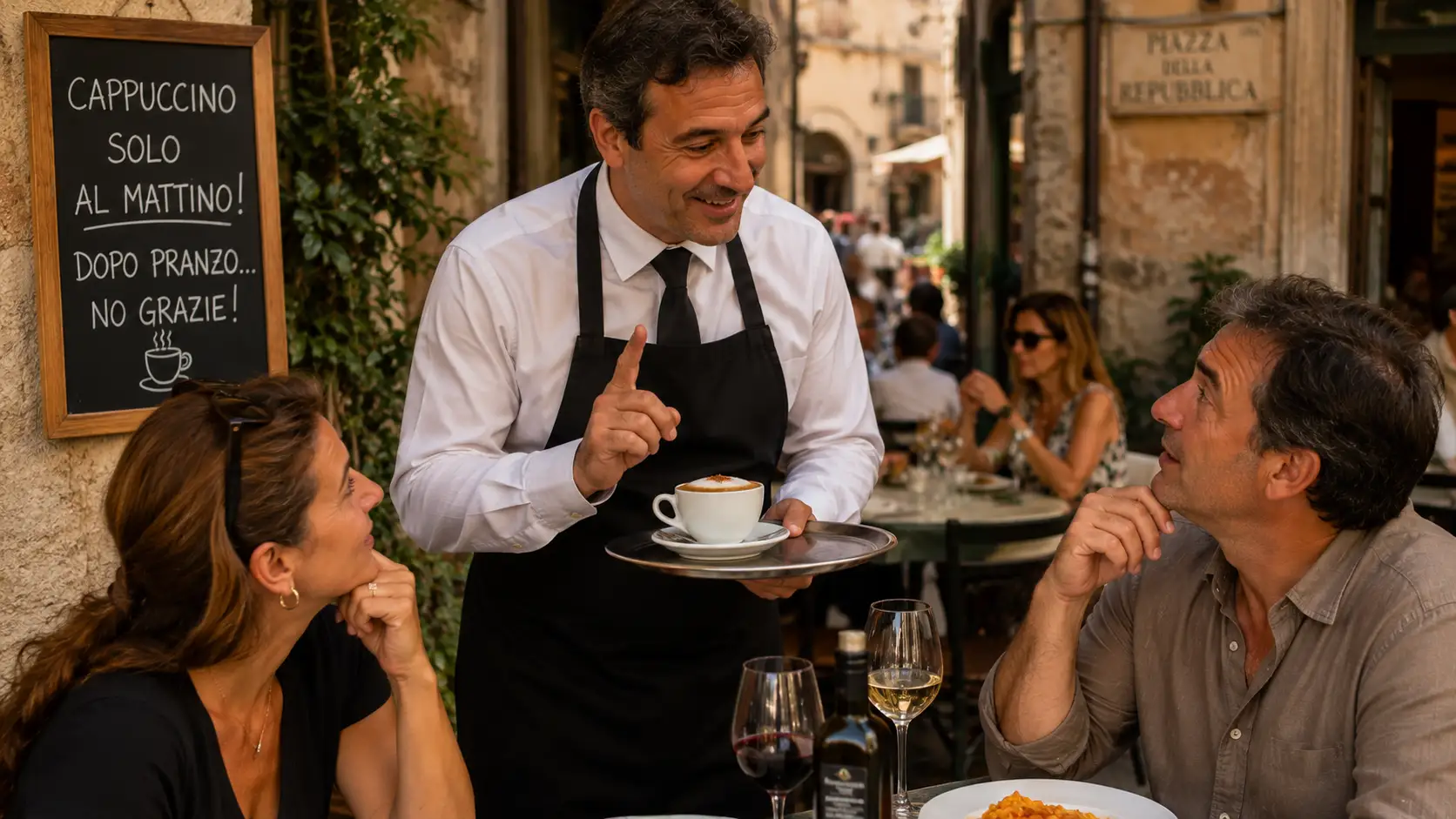
Lunch is over in an Italian restaurant. The plates disappear, and someone asks the table a familiar question: coffee?
A few tiny espressos arrive.
Then a visitor orders a cappuccino.
Nothing terrible happens. There is no law against it, and the waiter will probably make one. But to many Italians, the combination feels strangely out of place.
Why?
Because cappuccino is culturally treated as a breakfast drink in Italy. Its large amount of milk makes it feel substantial, almost like food in its own right, while the small, black espresso occupies the traditional role of coffee after lunch or dinner.
The famous rule is therefore less about caffeine and more about where a particular food belongs in the rhythm of the day. Lavazza describes cappuccino as traditionally consumed at breakfast, while espresso is drunk throughout the day.
To an Italian, ordering cappuccino after pasta can feel a little like ordering breakfast cereal after dinner.
Possible? Certainly.
Natural? Not usually.
Cappuccino Belongs to Breakfast
Walk into an Italian bar in the morning and the logic becomes obvious.
A typical breakfast, or colazione, is often light and sweet. Someone may stand at the counter with a cappuccino and a cornetto, pastry, biscuits or another baked item.
The cappuccino fits perfectly.
Espresso supplies the strong coffee flavor. Steamed milk adds richness and volume. Foam softens the drink. Together, the cappuccino can form a substantial part of a breakfast that might otherwise be quite small.
Eataly describes milky drinks such as cappuccino, caffè latte and latte macchiato as characteristic morning choices, while espresso takes over later in the day.
That is the key to the supposed prohibition.
Italians are not usually thinking, “It is now 11:01, therefore cappuccino is forbidden.”
They are thinking, often without consciously thinking about it at all, breakfast is finished.
So Why Does Everyone Say 11 A.M.?
Travel guides love a precise rule.
“Never order cappuccino after 11 a.m.” is memorable, so it has spread around the world as one of the classic commandments of visiting Italy.
But there is no national cappuccino clock.
Eleven in the morning is better understood as shorthand for the end of breakfast. Italian coffee guides consistently describe cappuccino as a morning drink, but the dividing line depends on the person and situation.
Someone having a late breakfast might order one later.
Someone else may want a cappuccino as an afternoon snack.
And in tourist areas, cafés serve them at virtually any hour.
The stronger cultural boundary appears after a meal.
A cappuccino directly after lunch feels more unusual than a cappuccino enjoyed on its own during the afternoon.
The Milk Is What Changes Everything
An espresso after lunch is tiny.
A cappuccino contains much more milk, making it heavier, creamier and more filling. That difference matters within Italian ideas about how a meal should end.
Many Italians traditionally describe a large quantity of milk after a substantial lunch as difficult or unpleasant for digestion. This helps reinforce the preference for black coffee instead.
But that should be understood as a cultural food belief, not a universal medical fact. There is no scientific rule saying that a healthy person must not drink milk after lunch.
What matters culturally is the perception.
A bowl of pasta, a second course, perhaps dessert, and then a large cup of steamed milk simply feels excessive to many Italian diners.
The espresso offers the opposite sensation.
It is short, intense and finished in a few sips.
Espresso Is the Period at the End of the Meal
Italian coffee is not one interchangeable beverage served in different-sized cups.
Different preparations occupy different social moments.
Cappuccino says morning.
Espresso can say morning, work break, afternoon pause or end of lunch.
Order un caffè in Italy and you will normally receive an espresso. There is usually no need to say the word espresso at all.
After a meal, that tiny coffee acts almost like punctuation.
Dessert may finish the eating.
Espresso finishes the meal.
It gives people a few more minutes at the table without introducing another substantial serving of food or drink.
That role is so established that an Italian may happily drink several espressos during the day while finding the idea of several cappuccinos distinctly strange.
What About a Caffè Macchiato?
Here the apparent rule becomes even more revealing.
A caffè macchiato is espresso “marked” with a small amount of milk or milk foam.
It is much more culturally acceptable after lunch than a full cappuccino.
Why?
Because the amount of milk is small enough that the drink still belongs mentally to the espresso family rather than the breakfast family.
This tells us that the taboo is not really “coffee and milk may never meet after noon.”
It is about proportion and category.
A little milk in coffee is one thing.
A cup dominated by steamed milk is something else.
Will an Italian Barista Refuse to Make One?
Usually not.
The image of an outraged barista throwing a tourist out for ordering cappuccino at 3 p.m. is mostly comic exaggeration.
Italian coffee-industry reporting in 2026 emphasized that the custom remains strong but is not an actual prohibition. Cafés, especially those accustomed to international visitors, routinely prepare cappuccino in the afternoon.
You may mark yourself as a visitor.
You might get a smile.
But you will almost certainly get your coffee.
Even Italians themselves do not all follow the convention equally.
Food culture contains habits, not police regulations.
The Rule Is Beginning to Bend
Italian eating habits are not frozen in time.
Brunch culture, international travel, specialty coffee shops and changing schedules are making the old boundaries more flexible.
In August 2026, illy described evening breakfast and “brinner” trends as challenging one of Italy’s most entrenched unwritten conventions: the idea that cappuccino belongs before midday.
That does not mean Italians suddenly began ordering cappuccinos after every dinner.
The traditional association remains powerful.
But younger consumers and urban café culture increasingly encounter foods outside the time slots their grandparents may have considered obvious.
Culture changes partly through exactly these small violations.
Today’s tourist mistake can become tomorrow’s ordinary menu option.
Why Food Timing Matters So Much in Italy
The cappuccino rule reveals something larger about Italian eating.
Food is often organized not only around what tastes good, but around what belongs together and when it belongs.
Certain foods feel appropriate for breakfast.
Others belong to lunch.
An aperitivo occupies its own part of the day.
Espresso follows meals.
These categories are learned so early that they can feel natural rather than cultural.
That is why an outsider can look at espresso, milk and foam and think, “Coffee is coffee.”
An Italian may see something more specific: breakfast has unexpectedly arrived after lunch.
Frequently Asked Questions
Is it illegal to order cappuccino after 11 a.m. in Italy?
No. There is no law or official rule. It is simply a strong cultural convention.
Do Italians ever drink cappuccino in the afternoon?
Yes. Individual habits vary, and modern café culture is becoming more flexible. The classic association, however, remains cappuccino with breakfast.
What coffee do Italians drink after lunch?
Usually a caffè, meaning an espresso. A caffè macchiato, espresso with a small amount of milk, is also possible.
Is cappuccino after lunch actually bad for digestion?
There is no universal medical rule against it. The idea that a milk-heavy coffee feels too substantial after a meal is primarily a cultural and personal preference.
Will Italians judge a tourist for ordering one?
Possibly in a playful sense, but most cafés will simply serve it. The idea that baristas routinely refuse afternoon cappuccinos is exaggerated.
The strange thing about the Italian cappuccino rule is that almost none of its ingredients are forbidden after lunch.
Coffee is fine.
Milk is fine.
The problem is what they become when combined in that particular cup.
To many Italians, a cappuccino does not simply have a flavor. It has a time of day. Once you understand that, the raised eyebrow after lunch starts to make sense.
Further cultural context
To keep italians avoid cappuccino after in perspective, explore related Daily World Culture stories and UNESCO Intangible Cultural Heritage. Strong cultural research compares sources, regions and generations instead of treating one memorable detail as universal.