Peruvians Decorate Llamas Colorfully can look surprising from the outside, but its meaning becomes clearer when history, place and everyday social rules are considered together. This guide explains peruvians decorate llamas colorfully with context rather than stereotypes.
Peruvians Decorate Llamas Colorfully: meaning and cultural context
- Peruvians Decorate Llamas Colorfully can vary by region, family, faith and generation.
- The custom may look different today than it did a generation ago.
- One striking practice should never be treated as a rule for every person in a country.
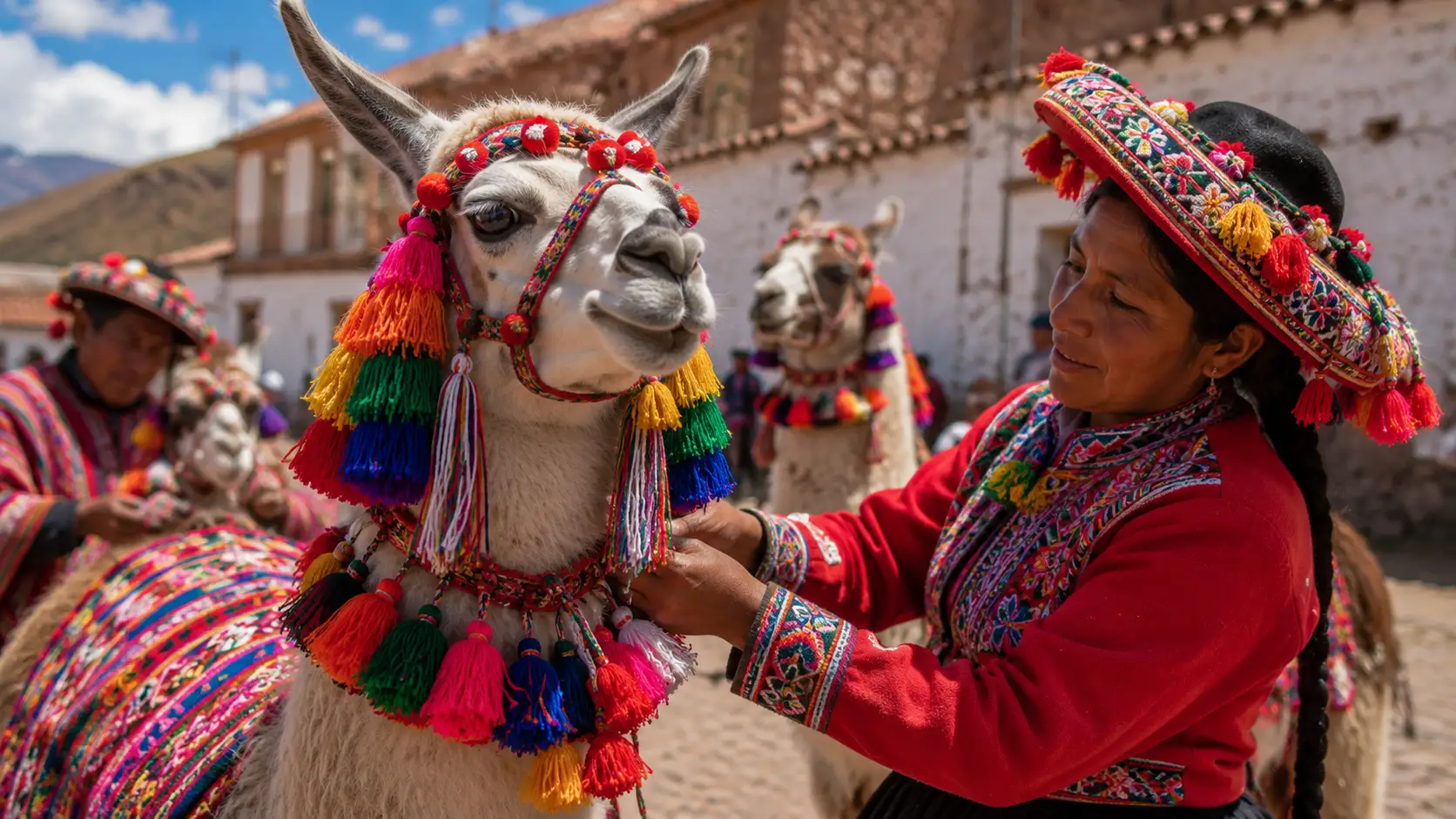
A llama stands in the Peruvian Andes with brilliant red tassels hanging from its ears. Another has pink, yellow and green wool woven into its decorations. In a festival procession, an entire group may appear dressed for celebration.
Why decorate an animal that is already famous for its thick, colorful fleece?
In many highland communities, the ribbons and wool ornaments are not simply decoration. They can identify which family an animal belongs to, mark an important livestock ceremony, express affection and care for the herd, and form part of rituals concerned with fertility and prosperity.
But there is no single llama decoration code used throughout Peru. Customs vary enormously between Quechua and Aymara communities, regions and individual families. And the heavily decorated llama a visitor sees near a tourist attraction may be dressed for a very different reason.
To understand the colors, it helps to stop seeing the llama as a decorative symbol of Peru and see it first as something much more important: a member of the herd.
Some Ribbons Are Actually Identification
In parts of the Andes, young llamas and alpacas take part in livestock marking ceremonies known by names such as señalakuy, señalachiy, cintachiy, herranza and others.
One official Peruvian cultural publication describes a ceremony in the Ayacucho region in which colored ribbons are inserted into the ears of llamas and alpacas. Families use particular combinations of ribbon colors together with distinctive ear marks to identify animals belonging to their herd. The ribbons can be replaced during later ceremonies, while the identifying ear mark is normally permanent.
So the bright tassel hanging from a llama’s ear may be doing something surprisingly practical.
It can say, in effect, this animal belongs with us.
Other Peruvian communities have their own systems. In one livestock festival documented in Junín, for example, different ribbon colors can indicate categories such as male, female, mother or breeding animal. Those meanings are local rather than national.
The colors may look playful to an outsider, but they can contain information understood by the people caring for the animals.
The Animals Are Being Celebrated Too
Identification is only part of the story.
Livestock marking in the Andes is often surrounded by music, food, dancing, offerings and celebration. Peru’s Ministry of Culture describes Quechua herranza traditions in which camelids may have their ears decorated with colored material while families perform rituals connected with the earth and the mountain guardians of the livestock.
In ethnographic accounts of Andean herding ceremonies, the ornaments are sometimes described as flowers, even when they are made from brightly dyed wool.
That language changes how the decoration looks.
The animals are not merely being tagged.
They are being dressed for an occasion.
Researchers studying livestock rituals across Peru have documented animals receiving colored wool ornaments while families sing, drink, dance and make offerings. In some ceremonies, people treat the herd with striking intimacy, using kinship-like language and emphasizing the dependence between animals and humans.
For pastoral families whose livelihoods have depended on camelids for generations, celebrating the herd is also a way of celebrating the continuation of the household.
Why Fertility Matters So Much
A herd has to reproduce.
That simple fact gives many Andean pastoral ceremonies their deeper urgency.
Healthy births mean more animals, more fiber, more transport capacity, more food and greater security for a family. Historically, llamas were enormously important in the Andes as pack animals and as sources of meat and fiber. They remain economically and socially important to many highland communities today.
This helps explain why livestock rituals often focus on multiplication, fertility and protection.
In some Quechua communities, ceremonies include offerings to Pachamama, often translated as Mother Earth, and to apus, powerful mountain beings or guardians within Andean religious traditions. Peru’s Ministry of Culture describes livestock marking ceremonies as containing propitiatory rites directed toward the earth and mountains associated with the protection of animals.
In Q’eros communities in Cusco, ethnographic research has also documented songs directed toward apus during rituals intended to encourage the fertility, abundance and long life of particular kinds of livestock, including llamas.
The colorful animal standing in the center of such a ceremony is therefore connected to something very serious: the hope that life will continue.
Are the Colors Sacred?
Not automatically.
This is where photographs can encourage overinterpretation.
It would be tempting to claim that every red tassel symbolizes one thing, every yellow ribbon another and every green pom-pom something else.
There is no universal Peruvian color dictionary for llamas.
Some communities use color combinations primarily to identify ownership. Others assign certain colors to categories of livestock. During festivals, colors may simply make the animal look festive and beautiful.
Regional traditions can also mix older Andean practices with Catholic feast calendars and more recent community customs.
The safest interpretation is not “every color has a secret spiritual meaning.”
It is that color itself helps transform an ordinary livestock moment into a visible social and ceremonial event.
Why Llamas Matter So Much in the Andes
For thousands of years, llamas have done work that would be difficult for many other domesticated animals at high altitude.
They can travel mountain routes carrying loads through landscapes where wheeled transport was historically impossible. Llama caravans once connected ecological zones of the Andes, moving goods between highlands and lower valleys.
They also supplied meat, fiber and other useful materials.
Long before the Inca Empire, Andean societies were already raising camelids. Under the Inca state, llamas became especially important for transportation and provisioning across an enormous mountain territory.
That history makes the modern image of the llama as a cute national mascot incomplete.
For pastoral communities, these animals were infrastructure.
They carried trade.
They carried food.
They helped households survive.
Decorating them can therefore express something closer to gratitude and relationship than to treating an animal as an ornament.
What About the Extremely Decorated Llamas Tourists See?
Visitors to places around Cusco and other popular destinations may encounter llamas covered in especially bright tassels, woven halters and textiles.
Those animals are not necessarily participating in a livestock marking ceremony.
In tourism settings, colorful decoration can make llamas visually distinctive for photographs, festivals or public events. Modern Peruvian camelid parades can also feature elaborately presented llamas and alpacas as celebrations of highland culture and livestock production. Peru’s government documented one such camelid parade in Puno in 2024, followed by a ceremony honoring llamas, alpacas and vicuñas.
This does not make the colors meaningless.
It means the context has changed.
A ribbon used to identify a family herd, a ceremonial wool “flower” attached during señalakuy, and a decorative tassel worn by a llama posing with visitors may look similar in a photograph while serving very different purposes.
It Is Not Something All Peruvians Do
Peru contains coastal cities, Amazonian communities, highland farming regions and millions of people who have no involvement with llamas at all.
So “Peruvians decorate llamas” is useful shorthand, but not literally true of the entire country.
The traditions discussed here belong especially to Andean pastoral communities that raise camelids, with significant local variation across areas such as Cusco, Puno, Ayacucho, Junín, Pasco and other highland regions.
Even within those communities, customs change.
Some ceremonies remain elaborate. Others have become smaller. New materials replace old ones. Public festivals reinterpret practices once carried out mostly within herding families.
Living traditions rarely stay exactly the same.
Frequently Asked Questions
Why do llamas have tassels on their ears in Peru?
In some highland communities, colored ribbons or wool ornaments form part of livestock marking ceremonies and can help identify the family that owns the animal.
Do the different colors have specific meanings?
Sometimes locally, but there is no universal Peruvian system. Colors can identify a herd or category of animal in one community while carrying different meanings elsewhere.
Are decorated llamas part of a religious ceremony?
They can be. Some Andean livestock ceremonies include offerings connected with Pachamama and mountain guardians, along with prayers or hopes for fertility and protection of the herd. But not every decorated llama is part of a religious event.
Are alpacas decorated too?
Yes. Many livestock marking traditions involve both llamas and alpacas, and sometimes sheep or cattle as well.
Are tourist llamas decorated for the same reason?
Not necessarily. Llamas used in tourism or public festivals may be decorated primarily for presentation, photography or celebration rather than herd identification or a pastoral ceremony.
The bright tassels are easy to notice because they make an already remarkable animal even more colorful.
But in the Andes, the more interesting story is the relationship underneath them.
A ribbon can identify an animal. A woolen “flower” can help mark a celebration. A ceremony can express hopes that the herd will grow and remain healthy.
What looks from outside like decorating a llama is often something much more familiar: people honoring the animals on which their families have long depended.
Further cultural context
To keep peruvians decorate llamas colorfully in perspective, explore related Daily World Culture stories and UNESCO Intangible Cultural Heritage. Strong cultural research compares sources, regions and generations instead of treating one memorable detail as universal.