Brazilians Wear White New can look surprising from the outside, but its meaning becomes clearer when history, place and everyday social rules are considered together. This guide explains brazilians wear white new with context rather than stereotypes.
Brazilians Wear White New: meaning and cultural context
- Brazilians Wear White New can vary by region, family, faith and generation.
- The custom may look different today than it did a generation ago.
- One striking practice should never be treated as a rule for every person in a country.
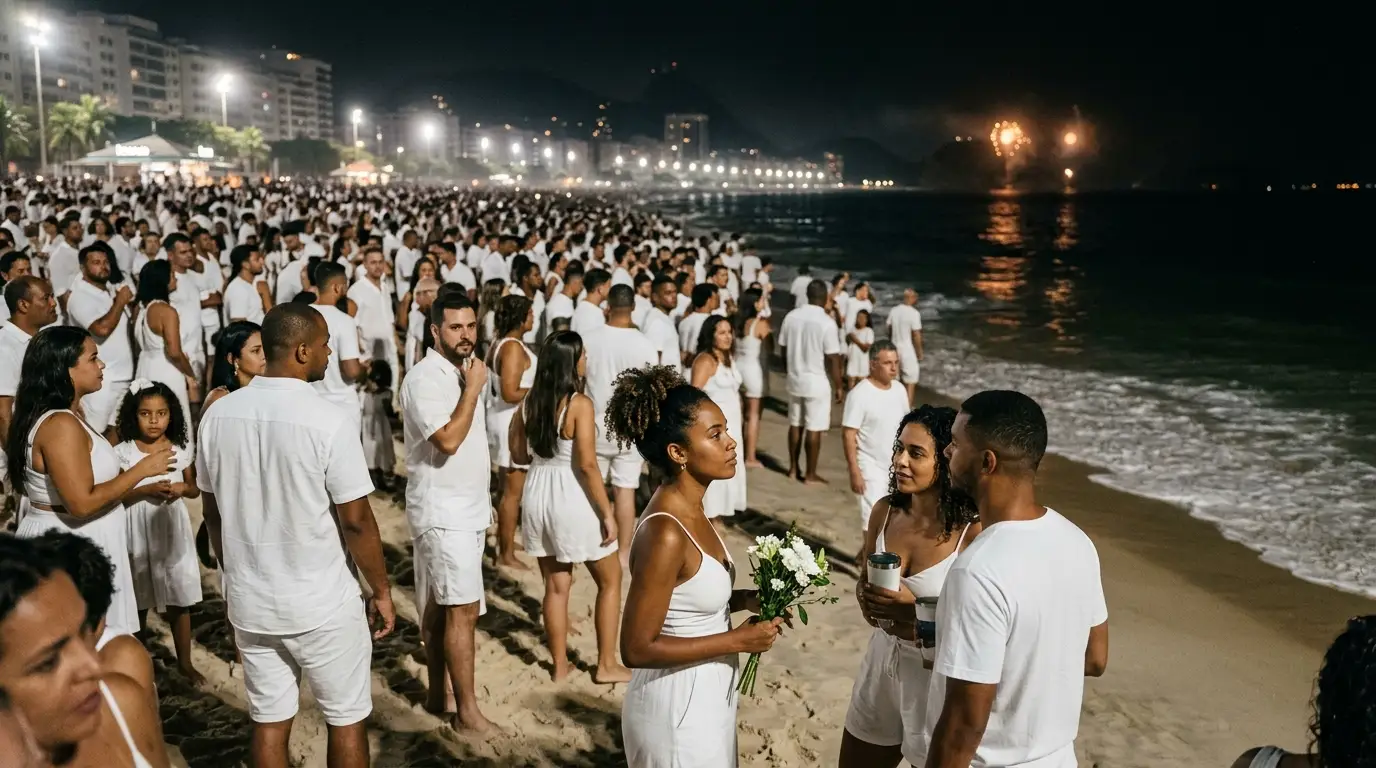
Just before midnight on December 31, Copacabana Beach begins to look almost unreal.
Millions of people face the Atlantic beneath fireworks and stage lights, yet one color dominates the sand: white. White dresses, white shirts, white trousers and white skirts turn the crowd into what Rio de Janeiro’s own tourism authority describes as a “white wave.”
Why?
Brazilians wear white on New Year’s Eve largely as a symbol of peace and renewal, but the custom has deeper roots in Afro-Brazilian religious traditions, especially Umbanda and Candomblé. Religious communities dressed in white during New Year’s ceremonies on Rio’s beaches, and over the twentieth century the practice spread far beyond those communities.
Today, millions of Brazilians wear white without necessarily thinking of religion at all.
That transformation is what makes the tradition so interesting.
The White Clothes Came Before the Giant Party
Modern Copacabana Réveillon is a massive public celebration, complete with concerts and fireworks. Its spiritual predecessor looked very different.
Research reported by Folha de S.Paulo traces an important organized celebration to the transition from 1949 to 1950, when followers mobilized by Umbanda leader Tancredo da Silva Pinto gathered at the beach dressed in white, saluted Iemanjá and brought offerings to the sea.
The event, known as Flores de Iemanjá, grew. More terreiros, or Afro-Brazilian religious communities, began participating. By later decades, people who were not members of Umbanda or Candomblé increasingly joined the beach celebration and adopted some of its visible customs.
Other accounts emphasize the 1970s as the period when white New Year’s clothing became broadly fashionable among the Brazilian public. Rather than a single moment of invention, the tradition appears to have expanded gradually from religious gatherings into mainstream Réveillon culture.
The enormous secular party came later.
But Is White Iemanjá’s Color?
This is where a common explanation becomes too simple.
Because New Year’s beach rituals often honor Iemanjá, the orixá strongly associated in Brazil with the sea, people sometimes conclude that everyone wears white simply because white is “Iemanjá’s color.”
The reality is more complicated.
White has broad importance within Afro-Brazilian religious life. It is particularly associated with Oxalá, an orixá connected with creation and peace in Candomblé traditions. The Joaquim Nabuco Foundation notes, for example, the longstanding Bahian practice of wearing white on Fridays in honor of Oxalá.
Iemanjá celebrations themselves can feature both white and blue. Bahia’s state government describes worshippers wearing those colors during the famous February 2 Festa de Iemanjá in Salvador.
So the New Year’s scene combines traditions that should not be collapsed into one explanation.
The white clothing has roots in Afro-Brazilian ritual practice. The seaside offerings are strongly associated with Iemanjá. Over time, white also became widely understood by the general public as the color of peace.
These ideas now overlap, even though they are not identical.
From Religious Clothing to a National Symbol of Peace
Once people outside the religions began copying the white clothing, its meaning broadened.
A Rio municipal cultural history describes the New Year’s custom as inherited from African and Afro-Brazilian religions such as Candomblé and Umbanda, while explaining that white came to represent the desire for peace.
That meaning is easy to carry across religious boundaries.
A Catholic can wear white.
An evangelical Christian can wear white.
An atheist can wear white.
Someone may simply think it looks beautiful beneath the fireworks.
The cultural gesture survived even when its religious origins were forgotten.
By 1981, a Brazilian newspaper was already describing white clothing as a familiar New Year’s custom while also reporting Umbanda and Candomblé practitioners gathering beside the sea with offerings to Iemanjá.
Today the result is visible far beyond Rio.
White has become the default visual language of Brazilian Réveillon.
And Then People Walk Into the Ocean
At midnight, another scene often follows.
Some people approach the water. They jump waves, make wishes or send flowers toward the sea.
These customs are also connected to Afro-Brazilian religious traditions, although participation today can be entirely secular.
Iemanjá occupies a particularly important place in Brazilian popular culture. She is an orixá with West African roots whose worship developed distinctive forms in Brazil, especially within Candomblé and Umbanda.
For practitioners, offerings to an orixá are religious acts, not New Year’s party tricks.
For other Brazilians, however, placing a flower in the sea or jumping seven waves may function more like inherited folk tradition. A person can repeat the gesture because their parents did it, because friends are doing it, or simply because it feels like a hopeful way to begin January.
That is how religious customs sometimes travel through a society.
Their meanings multiply.
Why Seven Waves?
Jumping seven waves is another familiar Brazilian New Year’s practice, particularly on the coast.
It is commonly connected with Umbanda and Afro-Brazilian religious symbolism. Some people make a wish with each wave, while others simply jump because it has become part of Réveillon tradition.
Not every Brazilian does this.
Someone celebrating hundreds of kilometers from the ocean obviously cannot walk into the Atlantic at midnight. Even among beachgoers, some people simply watch the fireworks.
Brazil is enormous, and New Year’s practices vary by region, religion and family.
Copacabana is the most internationally famous version, not the only Brazilian one.
Other Colors Have Meanings Too
White may dominate, but Brazilians do not have to wear it.
New Year’s clothing has also developed a playful color vocabulary. Some people choose yellow hoping for prosperity, red for love or other colors associated with particular wishes for the coming year.
Contemporary Brazilian explanations still describe white primarily in terms of peace and renewal. During the transition to 2026, even international coverage from Copacabana noted the overwhelming white clothing while Brazilians explained the symbolic meanings they assign to different colors.
Many people combine them.
A white dress might be paired with yellow jewelry. Someone may wear white clothes and red underwear. Others ignore the color symbolism completely.
There is no New Year’s dress code enforced by Brazilian society.
There is simply a remarkably strong tradition.
The Part of the Story That Is Easy to Forget
There is an uncomfortable historical irony in all this.
Afro-Brazilian religious practices have faced discrimination, suppression and persecution in Brazil. Yet several customs influenced by those same traditions became so popular that millions of people now participate in them without recognizing where they came from.
Recent reporting on the history of Copacabana’s Réveillon has highlighted precisely this contrast: white clothing and seaside rituals entered mainstream Brazilian culture while practitioners of Afro-Brazilian religions continued to face prejudice.
Recognizing the origin does not mean everyone wearing white is secretly performing a Candomblé or Umbanda ceremony.
They are not.
It means a national tradition can carry the fingerprints of communities whose contribution has sometimes been obscured.
Frequently Asked Questions
Do all Brazilians wear white on New Year’s Eve?
No. It is extremely common, but completely optional. Individual traditions vary by region, family and personal belief.
Does white mean peace?
For many Brazilians today, yes. Peace and renewal are among the most common popular interpretations of white at Réveillon.
Is wearing white an offering to Iemanjá?
Not necessarily. Many people wear white with no religious intention. Iemanjá is more specifically connected with seaside devotions and offerings, while white also has wider significance in Afro-Brazilian religious traditions.
Do Brazilians still follow the tradition?
Very much so. Recent New Year’s celebrations continue to turn Copacabana into a vast crowd dressed predominantly in white. Rio’s official tourism portal still describes the beach on December 31 as covered by a “white wave.”
Seen from above, Brazilian New Year’s Eve can look like millions of people independently made the same fashion decision.
They did not.
The white clothes carry a history that moved from Afro-Brazilian religious communities to Rio’s beaches and eventually into homes, parties and celebrations across the country. For some people the color still carries spiritual meaning. For others it simply means peace, hope and beginning again.
The clothing became universal precisely because its meaning could expand.
Further cultural context
To keep brazilians wear white new in perspective, explore related Daily World Culture stories and UNESCO Intangible Cultural Heritage. Strong cultural research compares sources, regions and generations instead of treating one memorable detail as universal.