Americans Tip Much can look surprising from the outside, but its meaning becomes clearer when history, place and everyday social rules are considered together. This guide explains americans tip much with context rather than stereotypes.
Americans Tip Much: meaning and cultural context
- Americans Tip Much can vary by region, family, faith and generation.
- The custom may look different today than it did a generation ago.
- One striking practice should never be treated as a rule for every person in a country.
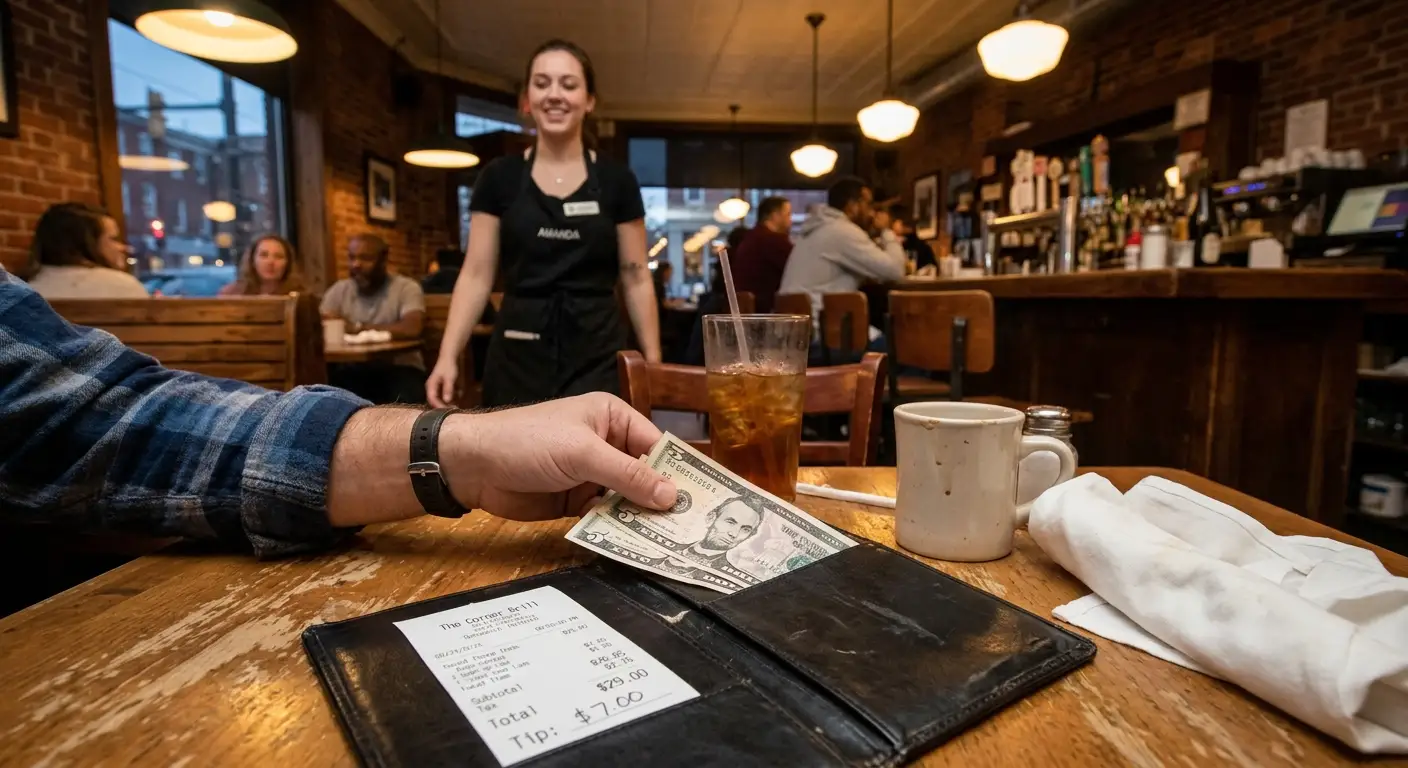
The meal is finished. The bill says $60. But in the United States, that often does not mean you are expected to pay $60.
A blank line waits beneath the total: TIP.
For visitors from countries where service is included in the price, adding another 15, 18 or 20 percent can feel strange. Why isn’t the restaurant simply paying the server and charging the customer the real price?
The answer is that American tipping evolved from a voluntary reward into part of the economic structure of many service jobs. In much of the country, restaurants can legally count customers’ tips toward employees’ minimum wages. At the same time, generations of social etiquette have turned a technically voluntary payment into something that can feel almost obligatory.
That is why Americans can call it a “tip” while treating it very differently from a small bonus.
In Some Jobs, the Tip Is Part of the Pay
The biggest clue lies in American wage law.
Under current federal law, an employer using the federal tip credit can pay an eligible tipped employee as little as $2.13 per hour in direct wages, provided wages plus tips reach at least the federal minimum wage of $7.25. If they do not, the employer is legally required to make up the difference. Many states set higher minimum wages, require larger direct payments or do not allow the federal arrangement to be used in the same way.
So it would be wrong to say every American waiter earns $2.13 an hour.
But the federal system reveals something fundamental: tips are not treated purely as an unexpected gift. The law itself recognizes them as part of compensation for many workers.
That changes the customer’s decision.
In a country where a server receives a full salary and a tip means “exceptional service,” leaving nothing may be perfectly normal.
In an American sit-down restaurant, leaving nothing can mean withholding a significant part of the income the system expects the worker to receive.
Tipping Was Not Originally an American Idea
There is an irony here.
Tipping came to the United States from Europe.
Wealthy Americans traveling in Europe during the nineteenth century encountered the practice of giving money to servants and service workers. Some brought the custom home, partly as a marker of sophistication and social status.
Many other Americans hated it.
Critics considered tipping aristocratic and incompatible with the idea that citizens of a republic should meet one another as social equals. Newspapers complained about the practice, labor organizations opposed it, and several states tried anti-tipping laws during the early twentieth century.
Yet the custom survived.
And in the United States it developed into something more economically important than it remained in many of the European countries from which Americans had borrowed it.
The History Also Runs Through Race
The American tipping system cannot be explained only as imported European etiquette.
After the Civil War and emancipation, tipping became deeply connected with occupations filled by Black workers, including restaurant servers and railroad porters.
Employers could hire formerly enslaved people and other Black workers for extremely low wages, or sometimes effectively expect customers’ gratuities to provide their income. The system allowed businesses to shift part of the cost of labor onto the people being served.
That history helped transform tipping from an elite affectation into a durable part of the American service economy.
This does not mean every modern tip is consciously connected to that history.
Most customers leaving money on a restaurant table today are not thinking about Reconstruction.
But customs can outlive the circumstances that helped create them. Once businesses, wages and expectations are built around a practice, it becomes difficult to remove.
So Is 20 Percent Actually Required?
No law requires a customer to leave 20 percent at an ordinary restaurant.
Social expectation is another matter.
Modern etiquette guides commonly recommend around 15 to 20 percent for table service, with 18 or 20 percent frequently presented as a normal choice. But Americans themselves do not agree on one exact number.
In a major Pew Research Center survey, 92 percent of Americans who ate at sit-down restaurants said they always or often tipped. Yet when asked what they would leave for average food and service, 57 percent chose 15 percent or less, while 25 percent chose 20 percent or more.
So the idea that “every American tips 20 percent” is exaggerated.
The stronger rule is that some tip is normally expected for conventional table service.
How much depends on the service, region, individual customer and increasingly the restaurant’s own payment model.
Why Is Everyone Asking for Tips Now?
Then comes the screen.
You order a coffee. The barista turns a tablet toward you.
20% 25% 30%
Suddenly the American tipping mystery becomes even stranger. No one carried plates to your table. You may not even have sat down.
This expansion is real.
In Pew’s survey, 72 percent of U.S. adults said tipping was expected in more places than it had been five years earlier. Only about a third felt it was very easy to know when to tip or how much.
Digital payment systems make asking effortless. A business can display suggested percentages on every transaction without anyone verbally requesting money.
But a tip screen does not automatically mean an established cultural obligation exists.
The same Pew study found that only 25 percent of people who bought coffee said they always or often tipped, compared with 92 percent of people eating at sit-down restaurants. At fast-casual restaurants, the figure was just 12 percent.
That distinction matters for visitors.
Americans themselves are confused by the newer requests.
A Tip and a Service Charge Are Not the Same Thing
Another surprise may appear directly on the bill:
20% service charge included.
Before adding another 20 percent, read carefully.
Under U.S. tax rules, a compulsory service charge is legally different from a voluntary tip. A true tip is an amount the customer is free to decide. A mandatory percentage set by the restaurant is treated as a service charge, even if the business calls it an automatic gratuity.
Restaurants also differ in what they do with service-charge revenue, so diners should check the bill or restaurant policy rather than assuming every charge works identically.
Some establishments have experimented with eliminating tipping entirely and raising menu prices or including service in other ways.
That model makes immediate sense to many international visitors.
But changing the American system is difficult because servers, restaurant owners and customers can all have different reasons for preferring or opposing tipping. Some experienced servers may earn considerably more from tips than they expect from a flat hourly wage. Restaurants worry about labor costs and menu prices. Diners are accustomed to controlling part of the server’s compensation.
The system persists partly because so many other parts of the system already assume it exists.
Why Americans Can Feel Obligated by Something “Optional”
This is the cultural heart of the mystery.
A tip occupies an unusual space between a price and a gift.
Legally, an ordinary voluntary restaurant tip is the customer’s choice. Socially, refusing to leave one after normal table service may communicate dissatisfaction rather than simple thrift.
Americans therefore learn an unwritten calculation.
Restaurant bill: $80.
Tax: added separately in most places.
Tip: also added separately.
The printed menu price was never the complete social price of the meal.
Someone raised in that system may barely notice the oddity. Someone arriving from Japan, Denmark, Australia or another culture with different service conventions notices it immediately.
Both reactions make sense.
Frequently Asked Questions
How much should you tip at an American restaurant?
For traditional sit-down table service, roughly 15 to 20 percent is a commonly cited range. Individual practice varies, and a mandatory service charge may already be included.
Is tipping legally required in the United States?
Ordinary voluntary tips generally are not legally mandatory. A compulsory service charge shown as part of the bill is different.
Do American servers really make only $2.13 an hour?
Some employers can use a federal tip-credit system with a direct cash wage as low as $2.13, but the worker must still receive at least the applicable minimum wage when tips are included, and many states impose stronger wage requirements.
Do you have to tip every time a payment screen asks?
No. Tipping expectations vary dramatically by service. Americans themselves tip much more consistently at sit-down restaurants than at coffee shops or fast-casual counters.
Why doesn’t America simply include service in the price?
Some businesses do. But tipping has been embedded in U.S. restaurant wages, pricing and customer expectations for generations, which makes replacing it more complicated than changing etiquette alone.
To an outsider, the American tip can look like extraordinary generosity: dinner costs one amount, then the customer voluntarily adds another fifth.
But the word “voluntary” hides much of the story.
America built a system in which the customer often does not merely reward the worker. The customer helps pay the worker. Once that is understood, the oversized tip becomes less mysterious, even if the system itself still seems unusual.
Further cultural context
To keep americans tip much in perspective, explore related Daily World Culture stories and UNESCO Intangible Cultural Heritage. Strong cultural research compares sources, regions and generations instead of treating one memorable detail as universal.