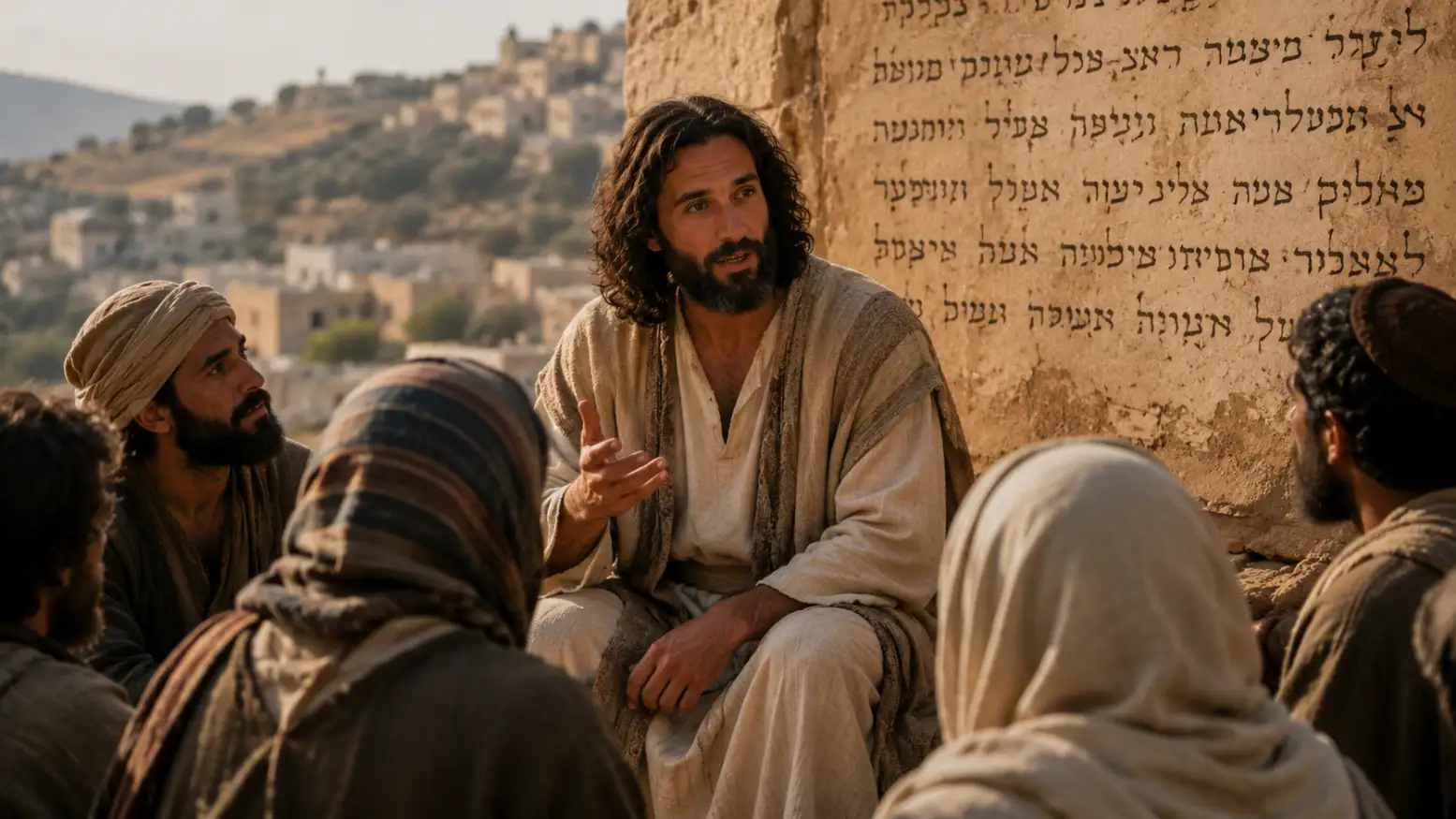
Language Jesus Christ Speak can look surprising from the outside, but its meaning becomes clearer when history, place and everyday social rules are considered together. This guide explains language jesus christ speak with context rather than stereotypes.
Language Jesus Christ Speak: meaning and cultural context
- Language Jesus Christ Speak can vary by region, family, faith and generation.
- The custom may look different today than it did a generation ago.
- One striking practice should never be treated as a rule for every person in a country.
Imagine standing in a crowded village in Galilee nearly 2,000 years ago. Jesus is speaking to fishermen, farmers, mothers, children and religious teachers. The words coming from his mouth would probably sound unfamiliar to almost every Christian alive today.
He would not normally have been speaking English, Latin or even the Greek in which most of the New Testament was written.
The language Jesus most likely spoke in everyday life was Aramaic, probably a Galilean variety of the language. Scholars also have strong reasons to believe that he knew Hebrew, and he may have been able to communicate in Greek as well.
That seemingly simple answer reveals something fascinating about the world Jesus lived in: it was multilingual.
Aramaic Was the Language of Everyday Life
Jesus grew up in Nazareth in Galilee and conducted much of his ministry among ordinary people in Galilee and Judea.
For many Jewish communities in that region during the first century, Aramaic was a normal language of daily conversation. It belonged to the same Semitic language family as Hebrew, but the two were distinct languages.
Aramaic had become enormously influential across the Near East centuries before Jesus was born. By the first century, varieties of Aramaic were widely used among Jewish communities in the region, while Hebrew continued to have an important religious and literary role.
So when Jesus spoke with his disciples, taught villagers or talked with families he encountered during his travels, Aramaic was probably the language heard most often.
The New Testament itself contains intriguing traces of it.
The Gospels Preserve Some of Jesus’ Aramaic Words
The Gospels were written in Greek, but several passages preserve words attributed to Jesus in Aramaic rather than simply translating them.
In Mark 5:41, when Jesus takes a young girl by the hand, the Gospel preserves the expression “Talitha koum”, commonly translated as “Little girl, arise.”
In Mark 7:34, another Aramaic expression appears: “Ephphatha,” meaning “Be opened.”
Mark also preserves “Abba” when Jesus prays in Gethsemane. The word means “father,” although its precise emotional tone should not be reduced to the sometimes repeated claim that it simply means “Daddy.”
Perhaps the most famous example comes from the crucifixion. Mark records Jesus crying words transliterated into Greek as “Eloi, Eloi, lema sabachthani?”, associated with the opening of Psalm 22 and translated as “My God, my God, why have you forsaken me?”
These preserved expressions are among the strongest reminders that behind the Greek text of the Gospels stood a world in which Aramaic was spoken naturally.
Then Why Was the New Testament Written in Greek?
This is where the story becomes more interesting.
If Jesus commonly taught in Aramaic, why do modern readers encounter his words primarily through ancient Greek?
Because Greek had become an international language across much of the eastern Mediterranean and Near East following the conquests of Alexander the Great and the centuries of Hellenistic influence that followed.
By the time of Jesus, the region was under Roman rule, but Koine Greek remained enormously important for commerce, administration and communication between people from different linguistic backgrounds.
The early Christian movement quickly expanded beyond Aramaic-speaking Jewish communities. Writing the Gospels and other New Testament texts in Greek allowed those writings to circulate among a much broader audience.
That means many familiar sayings of Jesus in the New Testament are probably Greek renderings of teachings originally delivered in Aramaic.
The situation is similar to hearing the translated words of a historical figure today. The translation can faithfully communicate the message even though it is not necessarily reproducing the exact sounds originally spoken.
Did Jesus Speak Hebrew Too?
Very probably, at least to some degree.
Hebrew had not simply disappeared in the first century. It remained deeply connected with Jewish scripture, religious learning and worship, while evidence also indicates continuing use beyond purely liturgical settings.
The Gospel of Luke describes Jesus entering the synagogue at Nazareth and reading from the prophet Isaiah. Whatever precise language practices accompanied synagogue readings at the time, Jesus’ participation in Jewish religious life makes knowledge of Hebrew highly plausible. Scholars therefore generally distinguish between Aramaic as his likely everyday language and Hebrew as another language he could have encountered and used in religious contexts.
The important point is not to imagine first-century Galilee as a place where everyone spoke only one language.
People could move between languages depending on whom they were speaking to and what they were doing.
What About Greek?
Jesus may also have known some Greek, but how fluently he spoke it remains debated.
Greek was certainly present in the wider region. Galilee existed within a world influenced by Hellenistic cities, commerce and Roman administration. Some scholars therefore consider it plausible that Jesus had enough Greek for at least certain interactions.
Others caution that evidence for widespread spoken Greek in the particular rural environment of Jesus should not be exaggerated. The archaeological and historical evidence does not allow us to reconstruct his exact level of fluency.
Several Gospel stories also place Jesus in conversations where Greek could conceivably have been useful, including encounters with Roman authorities and non-Jewish individuals. But the Gospels do not provide a linguistic transcript telling us exactly which language was used in every conversation.
So the careful conclusion is: Greek is possible and perhaps likely at some level, but Aramaic is much more securely identified as Jesus’ principal spoken language.
Did Jesus Speak Latin?
Probably not as an important everyday language.
This can seem surprising because Jesus lived under Roman rule. But Rome’s eastern territories were linguistically different from Rome itself. Greek remained extremely influential throughout the eastern Mediterranean.
Latin was associated particularly with Roman government, military and legal contexts, but a person living in Galilee did not need to conduct ordinary life in Latin simply because the Roman Empire controlled the territory.
Jesus may have encountered Latin words or speakers, but there is little reason to regard Latin as one of his normal languages.
What Would Jesus’ Voice Have Sounded Like?
This is the question historical evidence cannot fully answer.
We can study ancient Aramaic, inscriptions, manuscripts and related dialects, but no recording exists, and the exact pronunciation and individual qualities of Jesus’ speech are beyond recovery.
Even calling his language simply “Aramaic” can hide considerable complexity. Aramaic existed in numerous varieties across different regions and periods. Jesus’ speech would have belonged to the linguistic environment of first-century Galilee, not necessarily to every form of Aramaic spoken before or since.
Modern communities have also preserved varieties of Neo-Aramaic, but these should not be treated as perfectly unchanged recordings of the language Jesus spoke. Languages evolve.
Frequently Asked Questions
Was Aramaic the same as Hebrew?
No. They are closely related Semitic languages and share similarities, but they are distinct languages.
Did Jesus speak Greek?
Possibly. Many scholars consider some knowledge of Greek plausible because of the multilingual environment of the region, although his degree of fluency cannot be established with certainty.
Was the Bible originally written in Aramaic?
Not as a whole. Much of the Hebrew Bible was written in Hebrew, with some sections in Aramaic. The books of the New Testament were written predominantly in Koine Greek.
Can people still speak Aramaic today?
Yes. Modern varieties of Aramaic survive among several communities, although they have changed considerably over the centuries and some are endangered.
What was Jesus’ main language?
The strongest historical conclusion is that Aramaic was Jesus’ primary everyday spoken language, while Hebrew was also part of his cultural and religious world and Greek may have been available to him in certain situations.
The question matters because it brings Jesus out of later paintings, translations and church traditions and places him back into the living world of first-century Galilee.
His society was not linguistically simple. People prayed, traded, governed, studied and spoke at home in overlapping languages. What can look confusing from the modern world was ordinary to people living there.
The familiar words of Jesus have crossed languages for nearly two millennia. Behind their Greek manuscripts and thousands of later translations, we can still catch occasional echoes of the Aramaic voice in which many of them were first heard.
Further cultural context
To keep language jesus christ speak in perspective, explore related Daily World Culture stories and UNESCO Intangible Cultural Heritage. Strong cultural research compares sources, regions and generations instead of treating one memorable detail as universal.