Japanese Tea Traditions can look surprising from the outside, but its meaning becomes clearer when history, place and everyday social rules are considered together. This guide explains Japanese tea traditions with context rather than stereotypes.
Japanese Tea Traditions: meaning and cultural context
- Japanese Tea Traditions can vary by region, family, faith and generation.
- The custom may look different today than it did a generation ago.
- One striking practice should never be treated as a rule for every person in a country.
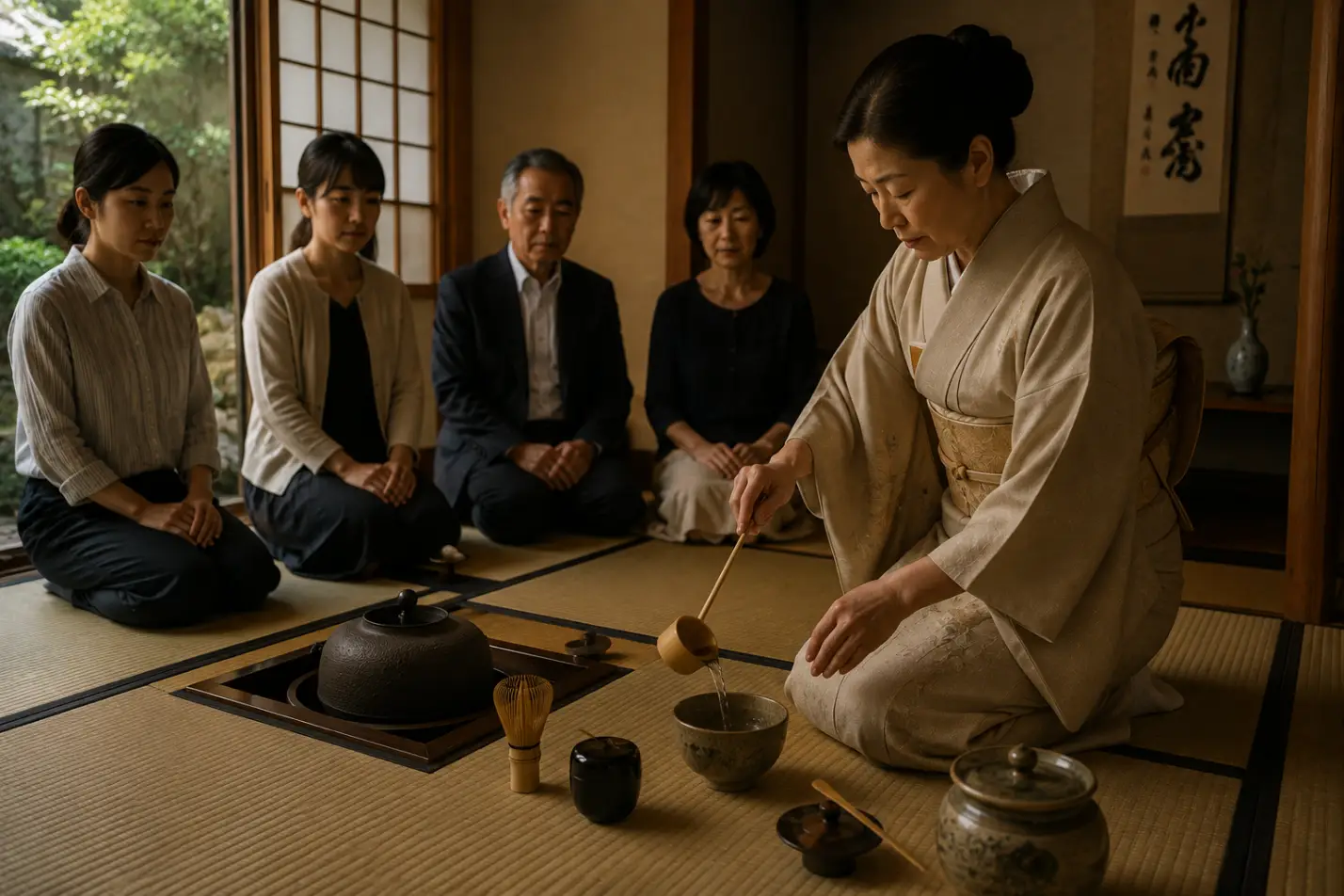
The room is quiet. A host lifts a bamboo ladle, pours hot water into a bowl, whisks powdered green tea, turns the bowl and presents it to a guest.
Nothing being done is technically necessary just to have a drink.
So why does making tea in Japan sometimes become an elaborate ceremony?
Because Japanese tea practice transformed an ordinary act of hospitality into a disciplined way of paying attention. In chanoyu, commonly called the Japanese tea ceremony, the bowl, room, flowers, utensils, season, movements of the host and behavior of the guest all contribute to a single carefully prepared encounter.
Tea is still tea. But the point is no longer simply to satisfy thirst.
Not Every Cup of Tea in Japan Is a Ceremony
The first thing to understand is that Japanese people do not ceremonially prepare every cup of tea.
Tea is an ordinary everyday drink in Japan. Bottled green tea comes from vending machines and convenience stores. Families drink tea casually at home. Restaurants serve it without elaborate ritual.
Chanoyu, meaning roughly “hot water for tea,” refers to a particular cultural tradition centered especially on powdered matcha.
Another term, chadō, means “the Way of Tea.” Urasenke, one of Japan’s major tea traditions, describes it as an aesthetic and spiritual discipline in which host and guest share a bowl of tea while giving careful attention to their encounter.
That distinction matters.
Tea did not become ceremonial because Japanese culture somehow requires ordinary actions to be complicated. A specific form of tea drinking was deliberately developed into an art and discipline.
Tea Came to Japan From China
Tea itself was not originally Japanese.
Tea drinking reached Japan through centuries of cultural exchange with China. Early tea was associated particularly with the imperial court and Buddhist communities. Later, the Zen monk Eisai, who returned from China around the end of the 12th century, helped promote powdered tea in Japan.
But the ceremony familiar today did not arrive fully formed.
Tea culture changed dramatically as it spread.
By the medieval period, members of Japan’s warrior and elite classes were organizing tea gatherings that could be surprisingly extravagant. Guests might participate in competitions identifying different teas, display expensive imported Chinese objects, gamble and drink alcohol.
This early tea culture could be about status as much as tranquility.
The quiet tearoom came later.
The Revolution Was Simplicity
Beginning in the 15th century, influential tea practitioners started moving away from dazzling displays of wealth.
Murata Shukō, followed by Takeno Jōō and eventually Sen no Rikyū, helped develop a style that found value in simplicity, restraint and objects that were not conventionally luxurious.
Instead of filling the room with prestigious Chinese treasures, tea masters increasingly appreciated Japanese and Korean ceramics, bamboo utensils, earthen walls and objects whose irregularities gave them character.
The Metropolitan Museum of Art notes that by the 16th century, Rikyū and other tea masters were elevating rustic Japanese and Korean ceramics alongside previously prized Chinese objects.
That change was enormous.
A rough bowl could become more meaningful than an expensive polished one.
A tiny room could become more powerful than a grand hall.
Sen no Rikyū Changed What Tea Could Mean
Sen no Rikyū, who lived from 1522 to 1591, is the figure most strongly associated with shaping the Way of Tea as it is understood today.
He did not invent Japanese tea drinking, nor did he single-handedly create chanoyu. He inherited traditions developed by earlier teachers and transformed them further.
Rikyū favored small, restrained tea rooms and simple utensils. Urasenke credits him with bringing the wabi style of tea to its mature form and elevating tea into a “way,” a discipline extending beyond the drink itself.
His tea world made deliberate simplicity meaningful.
Even the entrance to certain tea huts was made extremely small. Guests had to lower themselves to enter, regardless of social rank. Urasenke describes this as one way Rikyū challenged distinctions of status inside the tea space.
Outside, a powerful warlord might outrank a merchant.
Inside, both had to bow their heads.
Is the Tea Ceremony a Zen Buddhist Ritual?
Zen profoundly influenced the development of chanoyu, but calling the tea ceremony simply a Buddhist ritual would be misleading.
Tea had strong connections with Buddhist monasteries, and important tea masters studied Zen. Ideas associated with simplicity, discipline and complete attention to ordinary actions became important to tea culture.
Urasenke describes Murata Shukō’s tea as developing the idea that preparing and drinking tea could express a Zen understanding that ordinary actions themselves can become paths of cultivation.
But chanoyu also grew through merchant culture, warrior politics, art collecting, architecture, ceramics, poetry and social hospitality.
It is cultural practice shaped by several worlds.
Zen is part of the story, not the entire story.
Why Does Every Movement Matter?
A newcomer watching tea preparation may wonder why the host cleans an utensil in a particular way, turns a bowl or places objects so precisely.
The movements create attention.
When ordinary actions are performed slowly and deliberately, details that normally disappear become visible.
The sound of boiling water matters.
The texture of a tea bowl matters.
The placement of flowers matters.
Even the weather matters.
A traditional teaching attributed to Rikyū tells the host to make good tea, prepare properly, create coolness in summer and warmth in winter, arrange flowers naturally, anticipate rain and act with deep consideration toward guests.
The ceremony is therefore not primarily about memorizing complicated gestures.
The gestures train the host to notice what the guest might need.
The Season Enters the Room
A tea gathering is never completely separate from the world outside.
The host may choose flowers, sweets, ceramics and a hanging scroll that reflect the season or occasion. Different utensils can appear at different times of year.
Urasenke describes an ideal tea gathering as capturing the particular season, occasion, time and place.
This is one reason two ceremonies do not need to feel identical even when their basic procedures are highly structured.
The rules create a framework.
Within that framework, the host creates a particular moment for particular guests.
One Meeting That Cannot Be Repeated
One of the most compelling ideas connected with Japanese tea is ichigo ichie, often understood as recognizing that an encounter happens only once in exactly that form.
The people may meet again.
The same bowl may be used again.
Tea may be served in the same room tomorrow.
But this combination of guests, weather, conversation, mood and season will never occur in precisely the same way.
Urasenke places this sense of an unrepeatable encounter at the center of the relationship between host and guest.
Suddenly, the elaborate preparation makes more sense.
The host is not spending so much effort because tea is difficult to make.
The host is spending effort because the meeting matters.
Is the Tea Ceremony Still Practiced Today?
Yes.
Several tea traditions continue in Japan, including Urasenke, Omotesenke and Mushakōjisenke, all historically connected with the Sen family. There are also other schools and lineages, and their procedures are not identical.
Students can study tea for years, sometimes decades. Tea practice also exists in schools, cultural organizations, temples, private homes and public demonstrations.
At the same time, most Japanese people are not tea masters.
The ceremony is better understood as one important Japanese cultural art than as a routine followed by everyone.
Frequently Asked Questions
Is Japanese tea ceremony always performed with matcha?
Matcha is central to the best-known forms of chanoyu. Different preparations and gathering formats exist, but powdered green tea is fundamental to the tradition.
Why do guests turn the tea bowl?
In some tea schools and situations, a guest rotates the bowl as part of established etiquette, including avoiding drinking directly from its most distinguished front. Exact procedures vary by school.
What do harmony, respect, purity and tranquility mean?
Urasenke identifies these four principles as central to the Way of Tea. They describe relationships between people, the environment and the state of mind cultivated through tea practice.
Is wabi-sabi the same thing as tea ceremony?
No. Aesthetic ideas associated with simplicity, imperfection and restraint strongly influenced tea culture, particularly wabi tea, but the tea ceremony includes much more than one aesthetic concept.
Japanese tea becomes a ceremony when the goal changes.
If the goal is simply to drink, a few minutes are enough. If the goal is to notice the season, honor a guest, appreciate an imperfect bowl and give full attention to a meeting that will never happen in exactly the same way again, then even boiling water can become something larger.
The tea is ordinary.
The attention given to it is not.
Further cultural context
To keep Japanese tea traditions in perspective, explore related Daily World Culture stories and UNESCO Intangible Cultural Heritage. Strong cultural research compares sources, regions and generations instead of treating one memorable detail as universal.