Himba Women Use Red: meaning and cultural context
- Himba Women Use Red can vary by region, family, faith and generation.
- The custom may look different today than it did a generation ago.
- One striking practice should never be treated as a rule for every person in a country.
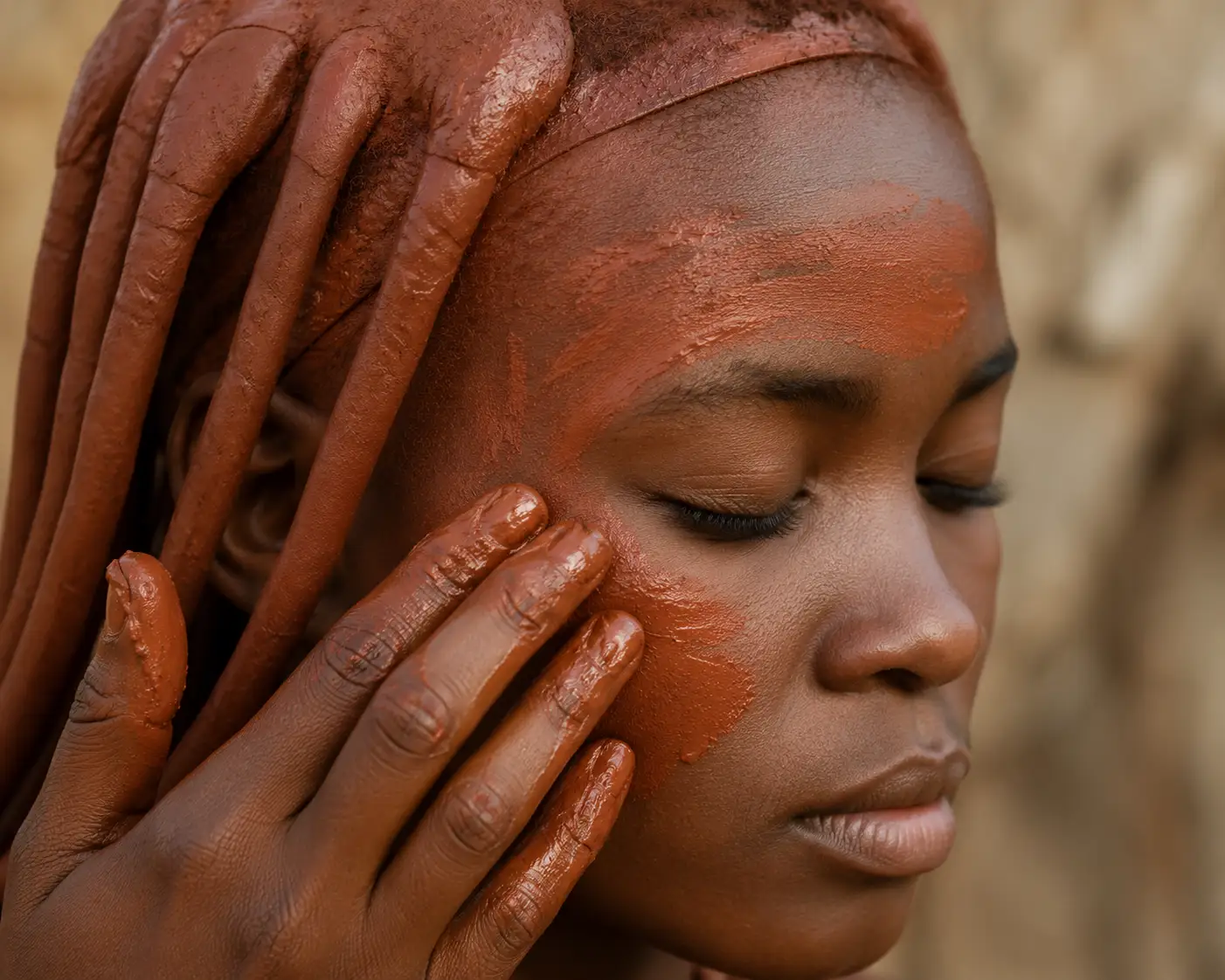
In northern Namibia, a Himba woman grinds a piece of deep red stone into powder. She mixes it with butterfat until it becomes a rich paste, then smooths it across her skin and works it carefully into her braided hair.
The result is unmistakable: a warm red-orange color that has become one of the most recognizable features associated with Himba women.
The paste is called otjize, sometimes spelled otjise. And although it can help protect skin in a hot, dry environment, describing it as “traditional sunscreen” misses much of the point.
Himba women use red ochre because otjize combines beauty, body care and cultural identity. The ochre can provide real protection from ultraviolet radiation, while the butterfat moisturizes the skin. But ethnographic research also shows that women themselves describe the red appearance as beautiful and distinctly Himba.
It is not simply desert survival painted red.
What Is Otjize Made From?
The striking color comes from red ochre rich in hematite, an iron oxide mineral.
Traditionally, pieces of ochre are ground into a fine powder and mixed with clarified butterfat. Aromatic plant resin, particularly from local Commiphora species known as omuzumba, may also be added, giving the mixture a fragrance.
The finished paste can be applied to the body, hair and sometimes personal ornaments.
Its color is so visually distinctive that outsiders often focus entirely on the pigment. But the fat matters just as much. In the dry climate of Namibia’s Kunene region, covering the skin with an oily mixture helps keep it conditioned.
Making and applying otjize is therefore closer to a combination of skincare, cosmetics, grooming and cultural dress than to simple body paint.
Does It Really Protect Against the Sun?
Yes, there is scientific evidence that the ochre itself can block ultraviolet radiation.
Researchers tested ochre samples obtained from Ovahimba women in northern Namibia and found that some had measurable sun-protective properties. Later laboratory work also found strong UV-filtering characteristics in the iron oxide-rich ochre used for otjize.
So the idea that red ochre offers protection against intense sunlight is not merely a tourist explanation.
But there is an important distinction.
Scientific researchers can demonstrate that the material protects skin from UV radiation. That does not prove that sun protection is the sole reason, or even necessarily the primary cultural reason, Himba women use it.
Ethnographic interviews point strongly toward beauty and identity as central meanings.
One study records Himba women describing the red appearance as part of being beautiful and recognizably Himba.
That makes otjize something more interesting than an ancient form of sunscreen.
It works practically, but it also communicates who someone is.
What Does the Red Color Mean?
Popular descriptions sometimes claim that red universally symbolizes the earth and blood, or “the essence of life,” for all Himba people.
That symbolism appears in modern academic descriptions of otjize, but cultural meanings should be treated carefully. Not every woman necessarily explains her daily use of the paste through the same symbolic language.
What is much clearer is that the red surface has become closely associated with an ideal of Himba feminine beauty.
Color, hairstyle, jewelry and clothing work together as part of personal presentation. Otjize is not an isolated substance painted onto an otherwise culturally neutral body.
It belongs to an entire visual language.
The Hair Can Tell a Story Too
Look at several Himba women and girls, and the hairstyles may not be identical.
That is important.
Among traditionally practicing Ovahimba, hairstyles can communicate stages of life and social status. Girls, young women and married women may wear their hair differently, and otjize is used to coat and shape many of these elaborate styles.
A young girl’s hairstyle can differ from that of an adult woman. Married women and mothers may also wear distinctive headpieces and arrangements.
These practices vary and have changed over time, particularly as education, urban employment and other aspects of contemporary Namibian life influence how younger people dress and style themselves.
So a photograph of red-coated braids is not merely showing a hairstyle.
Depending on the person and context, it may also be showing age, adulthood, marriage or another part of social identity.
Is Otjize Used Because Water Is Scarce?
Water scarcity is certainly part of the environment in which the practice developed.
Many Himba communities live in the arid Kunene region of Namibia and neighboring southern Angola. Water can be a valuable resource, and bathing practices have historically differed from those of societies where large quantities of water are available for daily washing.
Otjize helps cleanse and condition the skin without requiring frequent water-intensive bathing, and the oily layer can help with the effects of a dry, dusty climate. Researchers and Namibian cultural sources also describe protection from insects among its practical benefits.
But saying “Himba women use ochre because they cannot wash” is misleading.
It turns a deliberate beauty and grooming tradition into a story of deprivation.
Different cultures have developed different ways of cleaning, scenting, protecting and decorating the body. Otjize happens to accomplish several of those tasks at once.
Did Himba Men Ever Use It?
Yes.
The red appearance is now especially associated with women, but historical accounts and ethnographic research show that Himba men have also used ochre mixtures.
Research based on interviews in Namibia reports that habitual use among men declined significantly during the twentieth century. Otjize has also appeared in particular male ceremonies and life events.
This matters because photographs can create the impression that red ochre has always been exclusively a women’s substance.
Culture changes.
What becomes strongly gendered in one generation may have had broader uses in another.
Are All Himba Women Covered in Red Ochre Today?
No.
The Himba are a living population, not a preserved historical exhibit.
Some women maintain traditional clothing, hairstyles and otjize use closely. Others combine them with modern clothing or change their appearance depending on whether they are at home, at school, working in town or traveling.
Research in Namibia’s Kunene region documents substantial cultural change, including changes in hairstyles, dress, education and patterns of land use. At the same time, many people continue to value and maintain practices they consider important to Himba identity.
Modernity and tradition are not necessarily opposites.
A person can own a mobile phone, travel to town and still prepare otjize.
Frequently Asked Questions
What makes Himba women’s skin look red?
The color comes primarily from powdered red ochre containing hematite, mixed with butterfat to form otjize.
Is otjize actually sunscreen?
It can function as sun protection. Scientific testing has confirmed that some ochres used by Ovahimba women can significantly reduce ultraviolet exposure. But otjize also has important cosmetic and cultural meanings.
Do Himba women use otjize every day?
Traditionally, regular application forms part of grooming for many women, but individual practices vary, particularly in contemporary communities.
Do Himba men use red ochre?
Historically, men also used otjize. Regular use by men declined during the twentieth century, while the practice remains much more visibly associated with women today.
Where do the Himba live?
Himba communities live mainly in northern Namibia and neighboring southern Angola, particularly around the Kunene region.
Seen from outside, the red ochre can look like an ingenious response to a harsh desert environment. And in part, it is.
But protection alone cannot explain why the paste is prepared carefully, scented, applied to elaborate hairstyles and associated so strongly with beauty.
Otjize does not simply shield the body from the landscape. It helps present the body within a culture.
The red color catches an outsider’s eye. For many of the women who wear it, the deeper meaning is much closer to something familiar: taking care of yourself, looking beautiful and being recognizable as who you are.
Further cultural context
To keep himba women use red in perspective, explore related Daily World Culture stories and UNESCO Intangible Cultural Heritage. Strong cultural research compares sources, regions and generations instead of treating one memorable detail as universal.