Wedding Traditions: meaning and cultural context
- Wedding Traditions can vary by region, family, faith and generation.
- The custom may look different today than it did a generation ago.
- One striking practice should never be treated as a rule for every person in a country.
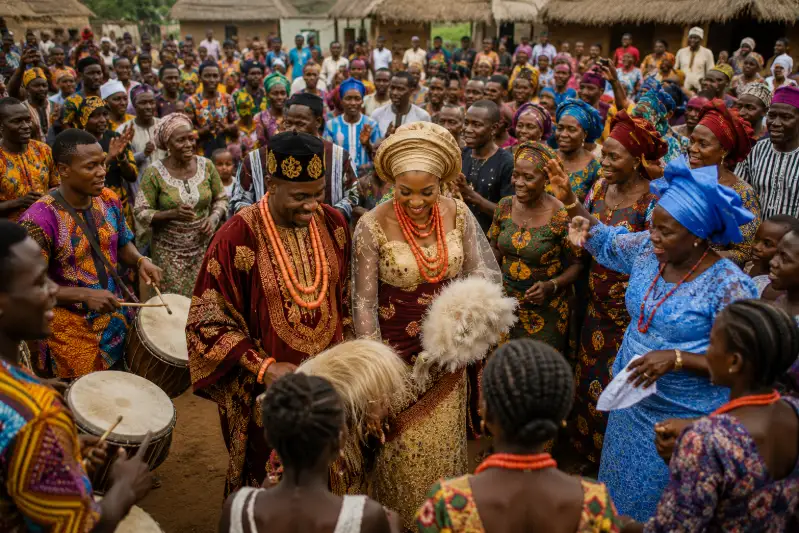
The bride and groom may be standing at the center of the celebration, but look around them. Aunties are cooking. Uncles are negotiating. Cousins are carrying chairs. Neighbors are arriving without behaving like distant spectators. Elders may have been involved long before the wedding day began.
To an outsider, some African weddings can seem enormous, almost as if an entire village has decided to get married.
In some communities, that impression points to something important: marriage has traditionally been understood not only as a bond between two individuals, but also as a relationship between families, kin groups and wider communities.
But Africa contains more than 50 countries and extraordinary cultural, religious and linguistic diversity. There is no single “African wedding,” and many weddings today are small, urban, private or modeled partly on global wedding traditions.
Where large community weddings do occur, however, the crowd is often doing more than celebrating.
The Wedding May Join Families, Not Just Two People
In much of contemporary Western wedding culture, the central story is usually the couple.
Two people choose each other. Their families attend.
In some African kinship traditions, the order can feel different. The couple still matters deeply, but marriage can also create obligations and relationships between larger groups of relatives.
Research on marriage in rural northern Ghana, for example, describes members of both extended families as important participants in marriage arrangements rather than treating the bride, groom and their parents as the only relevant people.
Among some isiZulu-speaking communities in South Africa, anthropological research similarly describes lobola as part of a process through which two extended families establish a relationship. The exact practices vary considerably by family and region.
So when grandparents, aunts, uncles and distant cousins become deeply involved, they may not see themselves as interfering with someone else’s wedding.
They may see the marriage as partly theirs too.
Why So Many Relatives Have a Role
To understand the size of some weddings, it helps to think beyond the modern nuclear family.
In communities where extended kinship remains socially important, relatives may provide financial assistance, labor, advice, introductions, childcare, housing or support during illness and hardship.
Marriage enters this network rather than existing outside it.
That means relatives may have responsibilities before the ceremony even begins. Depending on the community, family representatives might formally visit one another, discuss marriage arrangements, exchange gifts or take part in ceremonies acknowledging the new relationship.
In parts of northern Ghana, for example, bridewealth negotiations can involve wider paternal kin and a marriage liaison who helps connect the two families. Researchers emphasize that these practices differ significantly even across African communities where bridewealth exists.
The crowd at the wedding is therefore only the visible part of a relationship that may have been developing for months.
Sometimes Marriage Is a Process, Not a Single Day
This is another reason an African wedding can be difficult to understand if you expect one ceremony followed by one reception.
In some traditions, marriage develops through several stages.
Family introductions may happen first. Negotiations or gift exchanges may follow. There might then be a customary ceremony, a religious ceremony and a civil registration, sometimes on different dates.
Anthropologists studying marriage in parts of sub-Saharan Africa have long noted this process-like quality. Research in Zimbabwe, for example, discusses the contrast between Christian ideas of marriage occurring at a particular ceremonial moment and older understandings in which marriage relationships develop through a sequence of kinship transactions.
Even in South African law, customary marriage is defined in terms of being negotiated, celebrated or concluded according to the relevant customary system. The law recognizes that indigenous customary traditions themselves differ.
The “wedding,” then, may really be several moments in one larger social transformation.
Where Does the Village Come In?
Not every guest is necessarily a relative.
In tightly connected rural communities, neighbors may have relationships with a family stretching back generations. People may worship together, farm nearby land, attend the same funerals, celebrate births together and help one another during difficult periods.
A wedding therefore becomes a community event because marriage changes the social landscape around the couple.
The phrase “the whole village” should not be taken literally as a universal African custom. But in some places, excluding people who share a close social relationship with the family could feel stranger than inviting them.
Their presence also turns the ceremony into public recognition.
A marriage is not simply announced. It is witnessed.
Feeding Everyone Has Meaning
This helps explain another striking feature of many large weddings: food.
Cooking for hundreds of people may look wildly extravagant to someone accustomed to carefully counted reception seats. Yet communal feasting has a different logic.
Eating together makes the new relationship visible.
Guests are not only consuming a meal. Their participation confirms that something important has happened. Two families have changed. New relatives have appeared. Social relationships have been rearranged.
In southern African marriage traditions, historical research has shown how marriage was embedded in wider economic, political, religious and household relationships rather than existing as an isolated romantic institution.
Seen from that perspective, feeding a large gathering is less mysterious.
The marriage concerns more than two appetites.
What About Bridewealth?
Bridewealth is often misunderstood by outsiders.
Practices known by names such as lobola in parts of southern Africa involve transfers between families connected with marriage. These arrangements vary enormously, and reducing them to “buying a bride” can erase their social meaning while also ignoring legitimate modern debates about cost, gender and power.
Research from Ghana and South Africa shows that bridewealth may help formalize relationships between families, but it can also raise difficult questions about women’s autonomy, financial pressure and changing expectations.
Even within communities that value the tradition, people may disagree about how it should work today.
South Africa offers a useful example of why generalizations are dangerous. Its government states that lobola is not by itself required for a customary marriage to be legally valid. A marriage must instead meet the requirements of the particular customary system involved, alongside consent and other legal conditions.
Tradition is rarely as simple as outsiders expect.
Cities Are Changing the Picture
Africa is rapidly urban, connected and mobile.
A couple living in Johannesburg, Accra, Nairobi, Lagos or London may be balancing several worlds at once: family expectations, religious practice, customary traditions, civil law, personal preferences and the financial reality of organizing a large celebration.
Some couples still host enormous weddings.
Others limit invitations.
Some combine customary ceremonies with Christian or Muslim celebrations. Some simplify family negotiations. Some maintain certain traditions while questioning others. Interfaith and intercultural marriages can create entirely new combinations.
There can also be tension between generations.
Parents may understand a wedding as a family event, while the couple imagines something more private. Young adults may value traditional ceremonies but resist the expense associated with increasingly elaborate celebrations.
There is no single direction of change.
The Crowd Is Part of the Meaning
A visitor who sees hundreds of guests may initially wonder why so many people need to be there.
But that question assumes that a wedding belongs primarily to the bride and groom.
In some African communities, marriage has historically answered a larger question: How will two networks of people become connected?
That is why elders may negotiate, relatives may contribute money, neighbors may cook, cousins may work all day and guests who barely know the groom personally may still feel that they belong at the celebration.
The crowd is not necessarily surrounding the wedding.
Sometimes the crowd is part of what makes the wedding socially complete.
Frequently Asked Questions
Do all African weddings involve hundreds of people?
No. Wedding size varies enormously by country, ethnic community, religion, family, income and personal preference. Many African couples have small weddings.
Are marriages in Africa arranged by families?
Some communities have traditions involving strong family participation, but practices vary greatly. Today, many couples choose their own partners while still involving relatives in customary marriage processes.
Why are elders often important in traditional weddings?
In cultures where marriage links extended families, elders may represent those families, provide approval, participate in negotiations or help formally recognize the new relationship.
Is bridewealth practiced everywhere in Africa?
No. Bridewealth exists in various forms in some African societies, while others follow different traditions. Its meaning and practice also vary considerably between communities.
Are these traditions disappearing?
Some are changing, while others remain important and are being adapted to modern life. Urbanization, religion, migration, economics, law and generational preferences all influence how marriages are celebrated.
A wedding involving an entire community can look excessive if marriage is understood as a private promise between two people. Seen through a different idea of family, the same crowd becomes easier to understand.
Two people are getting married, but in some traditions, many more people are discovering that they now belong to one another.
Further cultural context
To keep wedding traditions in perspective, explore related Daily World Culture stories and UNESCO Intangible Cultural Heritage. Strong cultural research compares sources, regions and generations instead of treating one memorable detail as universal.