Arabs Eat Hands can look surprising from the outside, but its meaning becomes clearer when history, place and everyday social rules are considered together. This guide explains arabs eat hands with context rather than stereotypes.
Arabs Eat Hands: meaning and cultural context
- Arabs Eat Hands can vary by region, family, faith and generation.
- The custom may look different today than it did a generation ago.
- One striking practice should never be treated as a rule for every person in a country.
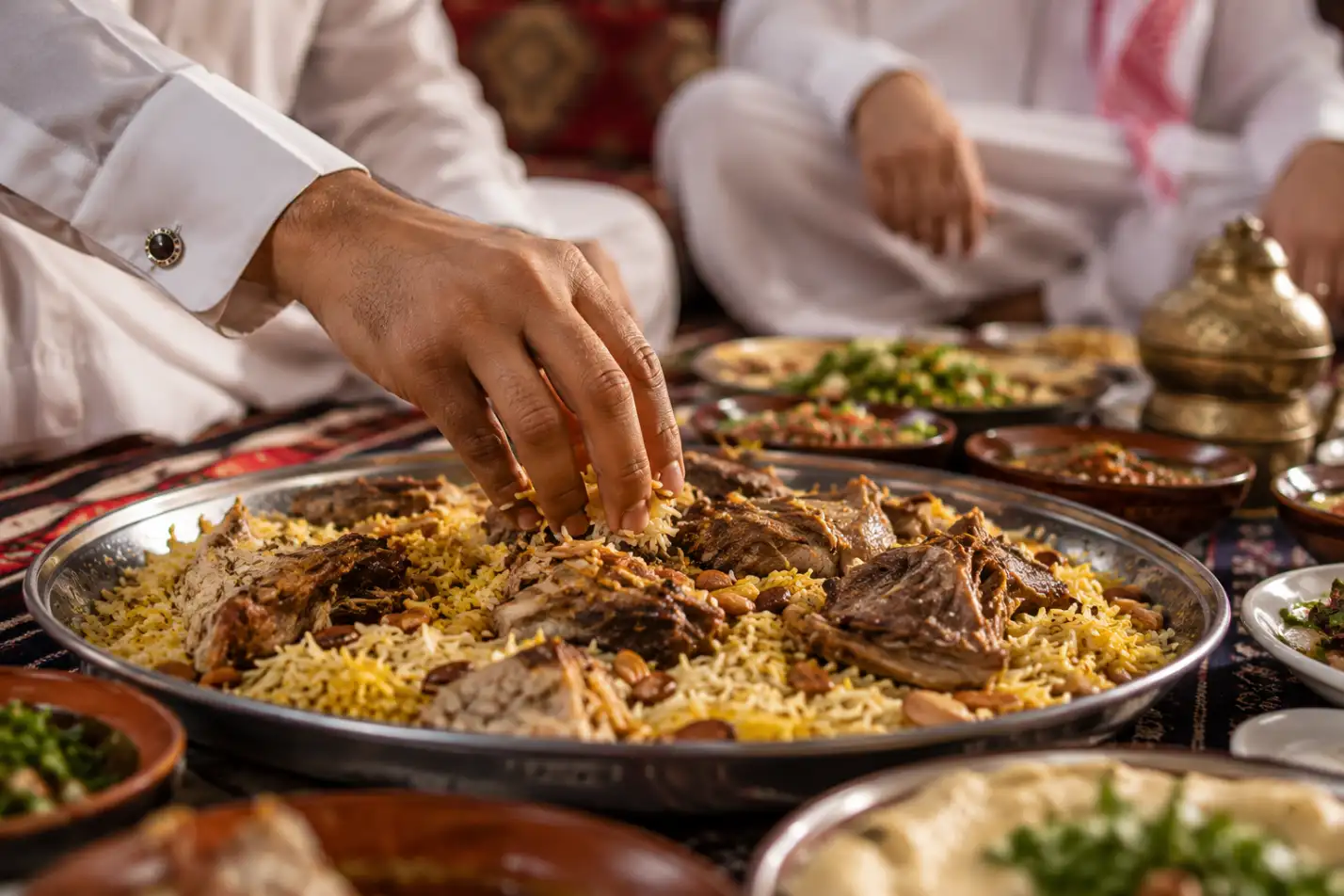
A large platter of rice and meat is placed in the center. People gather around it, and instead of reaching for forks, several diners begin shaping small portions of food with their fingers.
To someone raised to think of cutlery as proper table manners, the scene can raise an immediate question: why eat with your hands when utensils are available?
In many Arab communities, eating with the hand is not a substitute for cutlery. It is a traditional way of eating particular foods, especially bread-based dishes and communal meals, where touch, sharing and etiquette are built into the experience.
Religion also matters for many Muslim Arabs, particularly the custom of eating with the right hand. But Arabs are religiously and culturally diverse, and there is no rule that Arabs generally reject forks and spoons.
The real story is about what counts as a utensil in the first place.
Sometimes the Bread Is the Utensil
Consider a table covered with hummus, labneh, salads, dips and other small dishes.
A piece of flatbread can perform much of the work a fork or spoon might do elsewhere. It can be torn into a small piece, folded slightly and used to scoop food.
The fingers are not necessarily plunged directly into everything on the table.
Instead, the hand controls the bread.
This style of eating is practical because many foods across the Arab world developed alongside different forms of flatbread. Bread can scoop, pinch, wrap and carry food to the mouth.
Once you grow up eating this way, using a fork for every bite may seem no more inherently logical than using your fingers seems to someone else.
The difference is learned.
Some Meals Are Designed to Be Shared
Hand-eating becomes even more striking when several people gather around one large dish.
Jordanian mansaf offers a well-documented example. The festive meal typically combines meat, rice or bulgur, thin bread and a yogurt-based sauce. UNESCO describes guests traditionally sitting around shared platters, usually several people to one dish.
Traditionally, mansaf can be eaten directly with the right hand. Diners take food from the section in front of them rather than reaching randomly across the entire platter. Today, however, UNESCO notes that some people also use plates and spoons.
That detail matters.
The practice is alive, but it is not frozen in time.
A modern Jordanian may eat mansaf traditionally at a family gathering and use a fork at a restaurant the next day without seeing any contradiction.
Eating With Your Fingers Can Have Technique
People unfamiliar with hand-eating sometimes imagine that it simply means grabbing food.
Traditional etiquette can be much more controlled.
With rice dishes, experienced diners may use the fingertips to gather and compress a manageable amount before bringing it to the mouth. With bread, only a small torn portion may touch a shared dip.
The goal is often to avoid unnecessary mess and to respect the space of the people eating beside you.
This is especially important when a platter is communal.
In fact, an Islamic teaching recorded in Sahih al-Bukhari instructs a child to eat with the right hand and to eat from the portion nearest to him.
The lesson is not simply “use your hand.”
It is about how to behave while sharing food.
Why the Right Hand Matters
Among Muslim Arabs, the strongest formal dining rule concerns which hand is used.
Islamic teachings encourage eating and drinking with the right hand. A narration in Sahih Muslim gives that instruction explicitly.
This is why traditional communal eating is usually done with the right hand in Muslim settings.
The distinction is connected to a broader system of bodily etiquette in which the hands may be associated with different kinds of tasks. It also creates a clear convention when people are sharing food.
But this should not be confused with Arab identity itself.
Most Muslims in the world are not Arabs, and right-hand eating customs are also found in Muslim societies far beyond the Arab world. Arab Christians and members of other religious communities may also eat certain foods with their hands because the broader regional food culture is shared.
Religion and culture overlap here, but they are not the same thing.
The Practice Is About More Than Convenience
Food in many Arab societies carries a strong social meaning.
A meal can be a way of honoring a guest, reinforcing family relationships or marking a celebration. The physical arrangement of the meal can support that sense of togetherness.
Instead of everyone receiving an isolated plate, people may literally eat from the same dish.
That can change the feeling of the meal.
UNESCO describes harees, a traditional wheat and meat dish associated with the United Arab Emirates, Oman and Saudi Arabia, as being served in large dishes shared by several people. The organization notes that preparing and serving harees is associated with hospitality, generosity and social connection.
In that context, eating together is not just a delivery system for calories.
The shared dish is part of the social event.
This Does Not Mean Arabs Avoid Cutlery
Walk into restaurants, homes and cafés across the Arab world and you will find forks, knives and spoons everywhere.
Soup requires a spoon. Pasta will probably involve a fork. Restaurants serve cutlery. Formal meals may look little different from formal dining elsewhere.
Even foods traditionally eaten by hand can now be served with utensils depending on the person, family or setting.
Urbanization, international travel, restaurants and changing lifestyles have all influenced dining habits. But traditional methods do not necessarily disappear when modern ones arrive.
People simply gain more than one way to eat.
A person might scoop hummus with bread, eat rice with a spoon and later eat mansaf with the fingers at a family celebration.
All three can feel perfectly normal.
It Is Not One “Arab Custom”
The Arab world stretches across North Africa and Western Asia, encompassing more than 20 countries and enormous regional diversity.
Dining habits in Morocco are not identical to those in Iraq. Lebanese food traditions differ from Saudi ones. Rural practices can differ from urban ones, and one household may have very different expectations from the family next door.
Even the phrase “eating with the hands” covers several completely different behaviors.
It might mean tearing bread.
It might mean picking up a date.
It might mean eating a rice and meat dish from a communal platter.
It does not mean that every Arab meal is eaten without utensils.
Why Does It Still Feel So Natural?
Because table manners are rarely objectively obvious.
They become obvious after we learn them.
A child raised with forks learns not to touch food unnecessarily. A child raised around communal hand-eating may learn exactly which fingers to use, which part of the platter belongs to them and which hand is appropriate.
Each person eventually stops thinking about those rules.
They simply become “how people eat.”
That is why the same movement can look informal to one person and highly mannered to another.
Frequently Asked Questions
Do all Arabs eat with their hands?
No. Practices vary by country, family, religion, food and occasion. Cutlery is common throughout the Arab world.
What Arab foods are commonly eaten by hand?
Flatbreads, dates, sandwiches and some communal rice or meat dishes may be eaten by hand. The exact practice varies regionally.
Why do Muslims use the right hand?
Islamic teachings encourage eating and drinking with the right hand, so many Muslim families teach this etiquette from childhood.
Is eating from one communal platter still practiced?
Yes, in some contexts. Jordanian mansaf and Gulf harees are documented examples, although individual plates and utensils are also widely used today.
Is eating with your hands considered impolite?
Not when it is appropriate to the food and setting. In traditions where hand-eating is customary, doing it correctly can itself be a sign of good manners.
A fork can feel civilized only because someone taught us what to do with it.
At another table, the skilled movement of bread between the fingers, or several relatives sharing one carefully arranged platter, can carry just as much etiquette.
What looks like eating “without utensils” may actually be a different idea of what an eating utensil is.
Further cultural context
To keep arabs eat hands in perspective, explore related Daily World Culture stories and UNESCO Intangible Cultural Heritage. Strong cultural research compares sources, regions and generations instead of treating one memorable detail as universal.